A print or coating inspector looks at wet ink, a curing varnish or a freshly coated web under broadband process lighting, and the difference between a good and a bad decision is often which part of the spectrum the camera is allowed to see. Coloured optical glass that cuts the long wavelengths while keeping the blue and near-UV band is used to make that separation repeatable. The selection is a set of trade-offs between band position, batch colour consistency and how the filter behaves once it is glued into a moving web inspector.
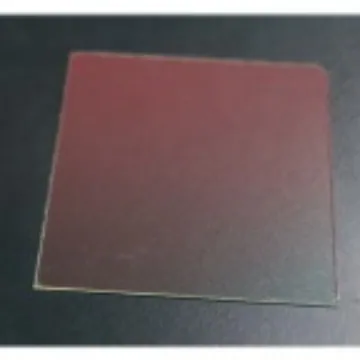
Optical Blue Glass in Printing and Coating Inspection
Inspection on a printing or converting line is a contrast problem before it is anything else. The same ink or coating that is correct on one roll can be thin, mottled or un-cured on the next, and the illumination under which the camera looks decides how big that difference appears. A blue-absorbing or blue-transmitting glass in front of the sensor fixes the spectral window so that the camera compares like with like, instead of the measured contrast moving around with the ambient light in the hall. The glass is used as a filter element rather than as a window, so its own colour is part of the specification and not an incidental property. In practice it is usually a flat or slightly wedged plate cemented into the inspection head, and its stability over months of shifts is what makes the inspection numbers comparable between shifts.
Coating and deposition considerations
Where the coloured glass is combined with a thin-film layer, the two need to be thought about together rather than bought separately. A hard-coated surface on top of a coloured substrate makes the edge of the transmission band sharper and the long-wavelength blocking deeper, which helps separate similar inks, but every added layer brings its own angle shift and its own reflection. Deposition uniformity matters across the aperture because a printed web is inspected over a wide field, and a band that sits slightly differently at the edge of the plate than in the centre appears as a systematic difference across the web that is easy to mistake for a coating fault. If the head is cleaned with solvent or wiped frequently, the top layer must be hard enough to take it, and the whole stack should be agreed with the coating supplier against the solvent the line actually uses.
What drives cost and lead time
Cost is driven mainly by the glass composition, the size of the plate and the flatness held across it. A standard catalogue coloured glass is considerably cheaper than a customized melt formulated for a particular band, and the customized route also brings a longer lead time because the composition has to be melted, tested and qualified before it is produced in volume. Plate size matters because coloured glass is normally cut from a cast block, and the usable yield from that block falls as the plate grows, so a large inspection window costs more than proportionally. Flatness and parallelism add metrology, and if the plate is to be cemented rather than clamped, the surface quality needs to be good enough to hold the cement layer evenly. The practical saving is to work out the band the camera genuinely needs and to move to a catalogue composition rather than ordering a bespoke melt for a small contrast improvement.
Substrate and material selection
The filter body is a coloured inorganic glass whose transmission band is set by its composition, and the choice is between a well-characterised catalogue type with a known repeatable band and a bespoke melt tuned to the exact edge the process needs. Catalogue types win on consistency and on delivery, because the same composition has been produced repeatedly and its batch variation is documented. A bespoke melt wins only when the spectral edge really is the discriminating feature and the two candidate states of the product differ only in a narrow band. Thickness is a selection variable in its own right: a thicker plate deepens the overall attenuation and shifts the band slightly, so the thickness must be stated with the composition, not chosen afterwards to fit a mechanical envelope. If the head sits in front of a UV curing lamp or near a process that emits strongly in the blue, the filter has to be checked for how it performs after sustained exposure rather than only on delivery.
How it compares with the alternatives
Against no filter at all, coloured glass makes the inspection repeatable under changing hall lighting, which is the reason most lines add it in the first place. Against a thin-film coated filter alone, a coloured substrate blocks deeply in the bands a dielectric stack handles less well and does it without a stack that shifts with angle, at the cost of a less sharp spectral edge. Against a software colour metric computed from a white-light camera, optical filtering is cheaper and more stable but less flexible, because changing the decision means changing hardware rather than a threshold. A polymer tinted filter is lighter and cheaper and can be shaped easily, but its optical stability under heat and solvent is inferior and its colour drifts more between batches, which is a poor trade on a line where the numbers must be comparable over months.
Common failure modes and how they show up
The failures seen on printing and coating lines are predictable. Colour drift between melts shows up as a slow change in the reject rate with no change in the product, and the usual response is to re-tune the thresholds, which hides the cause rather than fixing it. Thermal load near a curing lamp can change the apparent band over time, appearing as a gradual loss of separation rather than a sudden fault. Cement discoloration or a degrading adhesive produces a gradient across the plate that is read as a coating defect in one zone of the web only. Surface contamination from ink mist or coating overspray raises scattering and lowers contrast, and because it accumulates unevenly it tends to be blamed on the filter specification. In most cases the fix is to hold one qualified lot as a reference and to check the inspection consistency against it at scheduled intervals, rather than to keep changing the filter.
Requirements specific to Printing and Coating Inspection
A print or coating line needs a spectral window narrow enough to separate states of the ink or coating that look similar under white light, but wide enough that the contrast does not collapse when the hall lighting changes. Specify the composition and the thickness together, since thickness shifts the band, and decide early whether a catalogue type with documented lot variation is sufficient or the spectral edge is genuinely discriminating enough to justify a bespoke melt. Hold one qualified lot as a reference against which the reject rate is checked, and agree any deposited layer with the cleaning solvent used on the line.
- Composition and thickness specified together, because thickness shifts the band
- Catalogue glass preferred unless the spectral edge is the discriminating feature
- Hold one qualified lot as the reference for reject-rate comparison
- Check sustained exposure near UV curing lamps, not only delivery performance
- Agree any deposited layer against the line cleaning solvent
Framework references: transmission bands, surface quality and tolerances for optical filter components are conventionally stated in ISO 10110 and the relevant filter standard for the wavelength region in use; confirm values in the current issue of those documents rather than relying on a supplier datasheet. Statements about lot-to-lot colour variation are qualitative and should be verified against the chosen manufacturer's published data.
Selection data at a glance
| Parameter | Typical value | Notes |
|---|---|---|
| Selection point | Typical choice | Why it matters |
| Composition | Catalogue coloured glass | Documented lot repeatability |
| Thickness | Stated with composition | Shifts the band position |
| Plate size | Drives yield from cast block | Large plates cost disproportionately |
| Flatness | Holds cement layer evenly | Prevents false zone defects |
| Top coating | Hard layer vs solvent | Wipe durability on the head |
| Reference lot | One qualified physical sample | Keeps reject rate comparable |
Frequently asked questions
Is a bespoke melt worth it for a print line?
Only when the two states being separated differ in a narrow band and a catalogue glass cannot give enough separation. Otherwise a catalogue type with a documented band is cheaper, arrives sooner and gives a lot-to-lot variation you can actually measure against a reference.
Why does the reject rate drift without the product changing?
Because the filter is drifting. Colour variation between melts, slow thermal change near a curing lamp and accumulating ink mist on the filter surface all move the measured contrast, and the usual mistake is to re-tune the thresholds instead of referencing the inspection back to a held lot.
Can a polymer tinted filter replace the glass?
Mechanically yes and optically no. Polymer is cheaper and easier to shape, but it drifts more in colour between batches and copes worse with heat and solvent, which is a poor trade where the inspection numbers have to be comparable over months.
Need a quotation for optical blue glass?
Send your drawing, target specification or coating requirement and an optical engineer will reply within 24 hours with a price and a lead time.
Request a Quote Email an engineer