Optical Glass Cold Processing covers a wider range of options than most drawings imply, and the differences between them decide both performance and price. This article compares the practical choices available for IPL and beauty devices - substrate, coating process, thickness and tolerance - and shows where each trade-off pays off and where it does not.
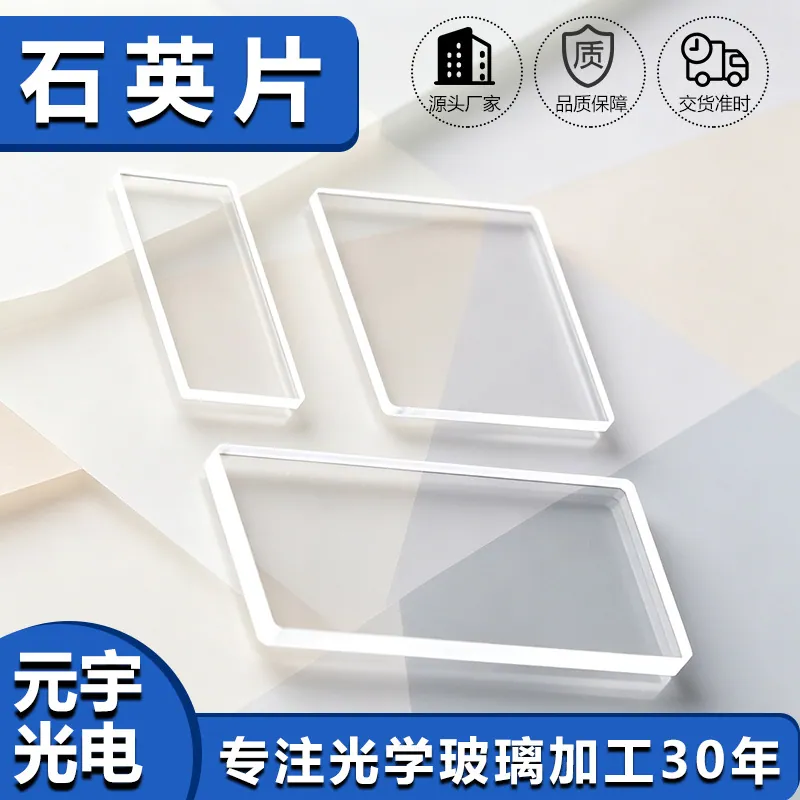
Optical Glass Cold Processing in IPL and Beauty Devices
In IPL and beauty devices, that translates into a specific set of requirements rather than a general preference for quality. Light-based beauty devices push high pulsed energy through a small filter, often at close range to skin. The filter has to define the treatment band precisely, block the wavelengths that would burn rather than treat, survive thousands of flashes without drifting, and stay cool enough not to injure the user. Cost matters too, because these are consumer products made in volume.
How it compares with the alternatives
Cold processing competes with three alternatives, and picking the wrong one is expensive. Hot pressing or molding produces aspheres and free-form shapes cheaply at volume, but leaves tool marks that need polishing and cannot hold interferometric flatness without it. Laser cutting and laser ablation skip the tooling and handle complex outlines and holes well, but leave a heat-affected edge and rarely hold tight surface quality on the cut face. Waterjet cutting is fast and thickness-agnostic but leaves a frosted edge that always needs finishing. For most flat optics with a coating and a defined surface figure - the majority of the parts used in IPL and Beauty Devices - conventional cold processing with CNC finishing remains the only route that delivers all three attributes at once: dimensional accuracy, optical surface quality and a coating-ready surface.
Coating and deposition considerations
Cold processing and coating are one continuous chain, and the interface between them is where most yield is lost. A polished surface must arrive at the chamber with a subsurface-damage layer thin enough that the ion-assisted deposition process can still reach a clean interface; grinding marks that survive polishing show up as scatter, and trapped polishing compound shows up as pinholes after the first warm-up cycle. Chamfers matter more than they look: a sharp edge creates a shadowed, poorly adhered zone and gives the coating a place to lift. For IPL and Beauty Devices, plan the coating before the glass is cut. Coatings that run close to the substrate edge, patterns that must be registered to a machined feature, and selective-area coatings all require locating marks or a mask that has to survive the fabrication steps.
What drives cost and lead time
Cost in cold processing is driven by three things: how much material has to be removed, how tight the tolerance is, and how many parts share the setup. Material dominates for sapphire, quartz and large blanks. Tolerance dominates whenever it forces a finishing operation - going from 60-40 to 20-10 scratch-dig roughly doubles polishing labor, and single-point diamond turning is a different cost class entirely. Batch size decides amortisation: a fixture that costs a few hundred dollars is irrelevant across 5,000 parts and decisive across five. The cheapest article to buy is almost never the cheapest to own, though. In IPL and Beauty Devices, a part that arrives with a consistent edge and a documented coating curve removes an incoming-inspection station, and that saving usually exceeds the price difference between two quotations.
Substrate and material selection
Material choice drives nearly every downstream decision. Soda-lime and B270 are cheap and polish quickly, so they suit cover glass and lighting filters where surface quality matters more than index control. Borosilicate 3.3 and Eagle XG bring low thermal expansion, which keeps flatness stable through the coating chamber and through soldering in IPL and Beauty Devices. Fused silica and quartz are chosen when UV transmission, high laser damage threshold or thermal shock resistance is specified; they cost three to eight times more and grind more slowly because of their hardness. Sapphire is the extreme case - nearly scratch-proof and thermally conductive, but it must be machined with diamond tooling and its anisotropy makes polishing direction-sensitive. State the material grade, not just the family: BK7 and B270 are not interchangeable, and a substrate substitution can move a filter's center wavelength by several nanometers.
Requirements specific to IPL and Beauty Devices
In IPL and beauty devices, that translates into a specific set of requirements rather than a general preference for quality. Light-based beauty devices push high pulsed energy through a small filter, often at close range to skin. The filter has to define the treatment band precisely, block the wavelengths that would burn rather than treat, survive thousands of flashes without drifting, and stay cool enough not to injure the user. Cost matters too, because these are consumer products made in volume.
- Cut-on between 470 and 650 nm depending on treatment
- Flash-to-flash stability over the device lifetime
- High flux tolerance with thermal shock resistance
- Cosmetic-grade finish on the user-facing surface
IEC 60335 and IEC 62471 photobiological safety context for the finished device, plus RoHS and REACH declarations for the component.
Selection data at a glance
| Parameter | Typical capability | Notes |
|---|---|---|
| Cutting tolerance | ±0.02 mm standard, ±0.01 mm on CNC | Diamond blade or scribe-and-break |
| Thickness range | 0.05-25 mm | Below 0.3 mm needs carrier fixturing |
| Edge chamfer | 0.1 - 0.3 mm x 45 deg | Edge chips held under 0.05 mm |
| Flatness | λ/4 to λ/10 at 633 nm | Pitch polishing on fused silica |
| Parallelism | ≤ 10 arcsec | Double-side polishing |
| Surface roughness | Ra ≤ 1 nm on polished faces | Ra 0.3 nm achievable |
| Scratch-dig | 40-20 to 60-40 | MIL-PRF-13830B / ISO 10110-7 |
| Minimum hole | 0.5 mm diamond, 0.1 mm ultrasonic or laser | Aspect ratio up to 5:1 |
| Prototype lead time | 5 - 10 working days | Volume runs 15 - 25 days |
Frequently asked questions
What is the fastest route from prototype to production?
Send the drawing and the application, and run the first article as a machined sample rather than a molded or cast part. Machined samples prove the tolerances and the coating at low cost, and the same CNC program then scales into volume production without a redesign.
What tolerances can cold processing realistically hold on glass?
Dimensional tolerances settle around ±0.05 mm as standard and ±0.01 mm with CNC finishing. Optical attributes are quoted separately: flatness to λ/4 or better, parallelism under 10 arcseconds, scratch-dig 40-20 commercially and 20-10 on request. The practical limit is set by how much you are willing to inspect, not by the machine.
Why does my part cost more when I only tighten one dimension?
A single tight dimension usually forces an extra operation and an extra inspection pass, and both are charged regardless of volume. Tightening a thickness from ±0.1 mm to ±0.02 mm can add a lapping stage; tightening surface quality from 60-40 to 20-10 can double polishing time.
Need a quotation for optical glass cold processing?
Send your drawing, target specification or coating requirement and an optical engineer will reply within 24 hours with a price and a lead time.
Request a Quote Email an engineer