A guarding window on a machining centre does a job no optical component was designed for. It is a coolant target, a chip catcher and a mounting surface at the same time, and it is usually replaced after something happens rather than on a schedule. The failures that reach the maintenance desk are almost always the same handful, and each one traces back to a decision that could have been made differently on the drawing. This note sets out those failure modes, how to measure them, and what to write on the specification.
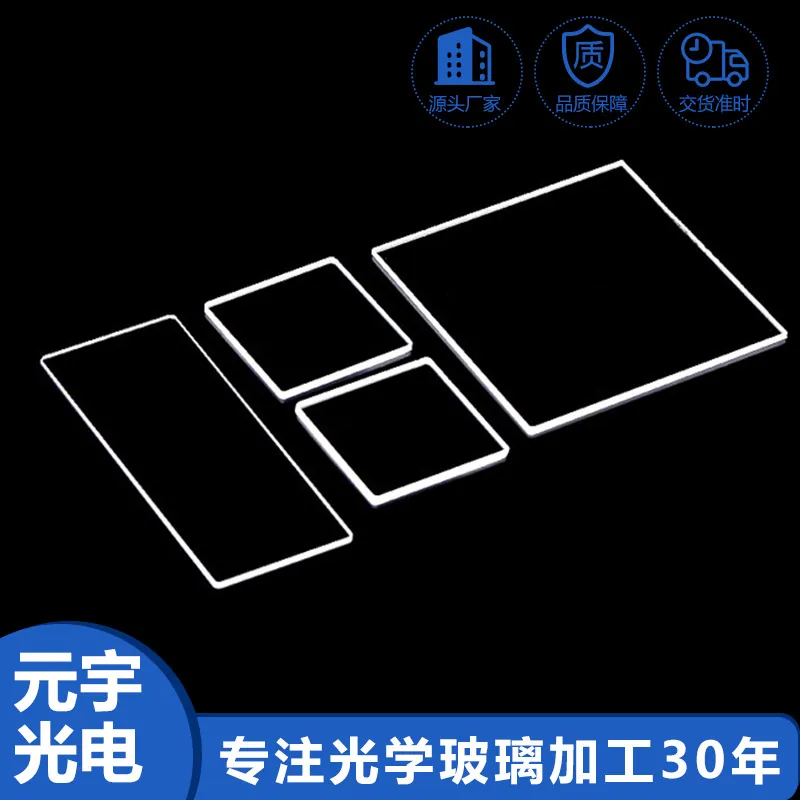
Optical Glass Cold Processing in Machine Tool and CNC Guarding
Cold processing covers grinding, polishing, edging, drilling and figuring of optical glass without changing its bulk chemistry, and on a machine tool the requirement is a window that survives a shop rather than a window that resolves diffraction-limited detail. The environment decides the specification: coolant arrives as a directed jet at temperature, interrupted cutting leaves hot chips that land on the inner face, and every tool change puts a burst of abrasive contamination into the enclosure. A typical part is a rectangular plate mounted in a hinged frame with a gasket, viewed through by a fixed camera on a gantry. The optical requirement is legibility of the workpiece; the mechanical requirement is that the pane survives being clamped and unclamped several hundred times.
Common failure modes and how they show up
Four failures dominate. Edge chipping appears at the chamfer or the drilled fixing hole, where a clamp or a screw loads the edge, and it is the most common cause of a pane that is still transmissive but no longer flat in its frame. Thermal shock fracture begins at the edge and runs through the plate, usually after a coolant interruption or a spindle warm-up. Splash and abrasion erosion pitting the inner face, where coolant carrying abrasive particles lands and is wiped dry repeatedly by the airflow, producing a haze that grows over weeks and is often mistaken for a coating problem. And figure or wedge drift after mounting, where the pane is clamped flat but the frame moves with the machine structure, so the image shifts as the enclosure warms. A fifth, coating loss, appears where a coated inner face was specified and the cleaning regime includes a solvent the coating was not qualified against.
Inspection and measurement
Measure what the shop will actually damage. Figure and irregularity by interferometry before any coating, surface quality against the scratch-and-dig limit with the part in the orientation it will be mounted, and edge and chamfer by optical or tactile inspection against an edge-chip limit stated on the drawing. Wedge and parallelism by autocollimation or equivalent, because a plate clamped in a frame whose tolerance is not controlled gains apparent wedge. Check the as-received coating separately: transmission and reflectance curves on the actual part, plus a cross-hatch or tape adhesion check if the coating is functional rather than cosmetic. Where the pane will see coolant, agree the qualification with the coolant and detergent in use rather than with a generic standard, because that is the variable that actually decides the life.
Coating and deposition considerations
Most guarding panes are specified with a simple anti-reflective treatment to cut the return from shop lighting, and some with a hard, thin-layer scratch-resistant surface to survive wiping. Both need to be qualified against the shop regime: repeated contact with an abrasive wiper, coolant droplets carrying fines, and thermal cycling between cold start and hot run. A hard coating that is not thick enough to survive the wiper will haze faster than an uncoated surface, and a soft AR stack on a pane that gets wiped is a poor use of money. State the coated face on the drawing, because on a hinged frame the two faces are not interchangeable, and specify whether the coating is a functional transmission requirement or a cosmetic one so the supplier knows how to qualify it.
Design rules that reduce cost
Most of these failures are designed out cheaply. Do not clamp on the optical glass: use a gasket and a frame that locates the pane on its edge with a clearance so thermal movement does not load the plate. Put the wiper side outside the coolant path where the machine layout allows, and if it cannot be moved, accept a thicker or harder-surface pane instead of a thinner cheaper one that will haze. Round or chamfer the edges generously, because the chamfer is where the stress concentrates and where a chip starts. Standardise on a blank size the supplier holds in stock rather than a custom rectangle, and keep the figure callout at what legibility requires, because a tighter specification than the camera can use is an expensive polish nobody benefits from. Finally, specify a spare-parts quantity with the same drawing revision, since replacement windows that differ in coating are a common cause of a camera that will never match its original image.
How it compares with the alternatives
Against polycarbonate and acrylic, cold-processed optical glass is far more scratch-resistant and dimensionally stable, and it does not creep or fog under coolant, but it will chip rather than flex and it costs more per part. Against sapphire, glass is much cheaper and easier to figure, but softer and more thermally expansive, so a pane that sees hot coolant repeatedly is a candidate for sapphire only where drop cost is not a constraint. Against laminated glass, a monolithic cold-processed pane avoids interlayer edge exposure but has no protection against impact. The practical trade is therefore cheap acrylic first for non-critical guards, monolithic optical glass where image quality or chemical exposure matters, and sapphire only where abrasion and thermal shock together justify it.
Requirements specific to Machine Tool and CNC Guarding
Machine tool and CNC guarding adds directed coolant jets, hot chips, abrasive wiper contact, vibration and frequent clamping cycles to the usual optical requirements. Mount the pane on a gasket with edge clearance rather than clamping on glass, and specify an edge-chip limit and a chamfer that removes the stress concentration. Qualify any coating against the coolant and detergent actually used in the shop, and keep the wiper face outside the coolant path where the machine allows. Where a camera image must be repeatable after replacement, issue the coating specification and drawing revision with the spare-parts kit so a replacement pane reproduces the original.
- Gasket mounting with edge clearance instead of clamping directly on glass
- Edge-chip limit and chamfer called out explicitly to remove the stress concentration
- Coating qualified against the shop's actual coolant and wiper regime, not a generic test
- Surface quality measured in the as-mounted orientation against a stated scratch-and-dig limit
- Drawing revision and coating spec issued with spare-parts kits so replacements reproduce the image
Framework references: ISO 10110 for surface figure, surface quality and edge-chip limits (for example ISO 10110-14 for edges). Where guarding is part of a machine's safety function, the relevant machinery or guarding standard and the machine builder's specification take precedence over an optical drawing, and should be confirmed against the current official text for the machine's market.
Selection data at a glance
| Parameter | Typical capability | Notes |
|---|---|---|
| Edge chip | Per ISO 10110-14 | Mounting stress |
| Surface quality | Scratch/dig per ISO 10110-7 | Wiper contact |
| Figure | PV ≤ 1 µm typical for guarding | Legibility only |
| Wedge | Measured in frame | Image stability |
| Coating | Hard thin-layer, if functional | Qualified vs coolant |
| Mounting | Gasket, edge clearance | No point loading |
Frequently asked questions
Why does a guarding window haze after a few weeks?
Usually splash erosion, not coating failure. Coolant carrying abrasive fines lands on the inner face and is wiped dry by the airflow, so the same particles are repeatedly dragged across the surface. Moving the wiper side out of the coolant path, or specifying a harder surface for that face, fixes it; replacing the coating rarely does.
Can a metal guard frame hold the pane without a gasket?
Not without accepting the risk. A rigid frame that grips the glass directly loads the edge, which is where chips start, and it transfers frame movement into figure change as the enclosure warms. A gasket with edge clearance lets the pane locate without being stressed.
Is optical glass overkill for a machine guard?
For image quality or chemical exposure, no. Optical glass is dimensionally stable, resists coolant and does not fog. If the guard only needs to stop chips and nobody looks through it, acrylic is the right part and glass is simply more expensive.
Need a quotation for optical glass cold processing?
Send your drawing, target specification or coating requirement and an optical engineer will reply within 24 hours with a price and a lead time.
Request a Quote Email an engineer