Two quotations for the same optical glass cold processing part in stage lighting and entertainment can differ by a factor of three, and the reason is rarely the material. This article breaks down the real cost drivers - tolerance, finishing operations, inspection level and batch size - and shows which specification changes save money and which only look as though they should.
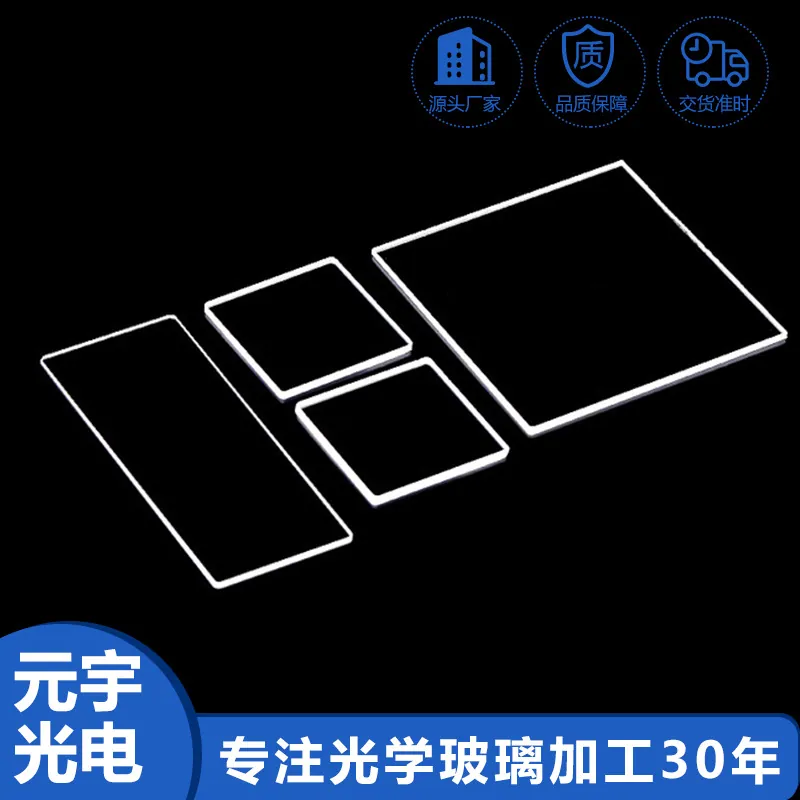
Optical Glass Cold Processing in Stage Lighting and Entertainment
In stage lighting and entertainment, that translates into a specific set of requirements rather than a general preference for quality. Entertainment lighting combines the highest continuous flux of any application with the least forgiving audience: a stadium or a theatre instantly reveals color drift or a hazy filter. Gobo and color plates sit a few millimeters from a lamp, are expected to hold their color for thousands of hours, and are frequently handled and swapped between shows.
What drives cost and lead time
Cost in cold processing is driven by three things: how much material has to be removed, how tight the tolerance is, and how many parts share the setup. Material dominates for sapphire, quartz and large blanks. Tolerance dominates whenever it forces a finishing operation - going from 60-40 to 20-10 scratch-dig roughly doubles polishing labor, and single-point diamond turning is a different cost class entirely. Batch size decides amortisation: a fixture that costs a few hundred dollars is irrelevant across 5,000 parts and decisive across five. The cheapest article to buy is almost never the cheapest to own, though. In Stage Lighting and Entertainment, a part that arrives with a consistent edge and a documented coating curve removes an incoming-inspection station, and that saving usually exceeds the price difference between two quotations.
Substrate and material selection
Material choice drives nearly every downstream decision. Soda-lime and B270 are cheap and polish quickly, so they suit cover glass and lighting filters where surface quality matters more than index control. Borosilicate 3.3 and Eagle XG bring low thermal expansion, which keeps flatness stable through the coating chamber and through soldering in Stage Lighting and Entertainment. Fused silica and quartz are chosen when UV transmission, high laser damage threshold or thermal shock resistance is specified; they cost three to eight times more and grind more slowly because of their hardness. Sapphire is the extreme case - nearly scratch-proof and thermally conductive, but it must be machined with diamond tooling and its anisotropy makes polishing direction-sensitive. State the material grade, not just the family: BK7 and B270 are not interchangeable, and a substrate substitution can move a filter's center wavelength by several nanometers.
Handling, cleaning and packaging
Thin and coated glass fails in handling more often than in machining. Below roughly 0.5 mm, parts flex enough that vacuum chucks leave marks and ultrasonic energy can crack edges, so the work is carried on sacrificial plates or wax-mounted to a carrier. After coating, the surface must never touch anything: shippers use a cleanroom-compatible interleaf, edge-protecting trays and, for high-value parts, individual die-cut pockets. Cleaning follows a fixed recipe - alkaline or neutral detergent, cascaded DI rinses, IPA or nitrogen dry - because a change in rinse water quality is enough to leave mineral staining that only appears after the customer's reflow or autoclave cycle. Every handling step in Stage Lighting and Entertainment should be specified in writing, including the packaging standard, or the same part will arrive in perfect condition once and damaged the next time.
The tolerances that actually matter
Tolerances should be assigned per feature, not globally. Dimensional tolerances of ±0.05 mm are standard and almost free; tightening to ±0.01 mm typically adds a CNC step and a second inspection pass. Optical tolerances are a different currency: flatness is quoted in fringes (one fringe at 633 nm equals 316 nm of sag), surface quality in scratch-dig (40-20 is a normal commercial grade, 20-10 is precision), and parallelism in arcseconds. In Stage Lighting and Entertainment, the tolerance that usually decides the price is the one nobody writes down - for example the edge chip allowance, the chamfer uniformity, or the difference in thickness across a 100 mm part. Specifying a tolerance that no fixture can hold forces the shop to sort parts instead of making them, and sorting is what turns a two-week lead time into a six-week one.
Design rules that reduce cost
A drawing that respects how glass behaves costs less and ships faster. Keep holes at least one thickness away from an edge and at least two thicknesses apart; glass does not tolerate a thin web between two holes. Replace sharp internal corners with radii of at least 0.5 mm, because a sharp corner is a crack starter. Respect the aspect ratio - a 1 mm hole in 5 mm glass is practical, a 1 mm hole in 20 mm glass is not without ultrasonic or laser drilling. Specify the chamfer rather than leaving it to the shop; an unspecified edge will be whatever the operator considers normal. For Stage Lighting and Entertainment, also state the reference surface: which face is the optical face, which datum sets the outline, and whether a coating pattern must register to a machined feature. Half of all first-article queries trace back to an ambiguous datum rather than an impossible tolerance.
Requirements specific to Stage Lighting and Entertainment
In stage lighting and entertainment, that translates into a specific set of requirements rather than a general preference for quality. Entertainment lighting combines the highest continuous flux of any application with the least forgiving audience: a stadium or a theatre instantly reveals color drift or a hazy filter. Gobo and color plates sit a few millimeters from a lamp, are expected to hold their color for thousands of hours, and are frequently handled and swapped between shows.
- Sustained high flux tolerance without color shift
- Patterned colors with registration to ±0.05 mm
- Heat-resistant substrate such as borosilicate or quartz
- Robust coated edge for repeated handling
EN 60598 luminaire safety context, fire-behavior considerations for stage materials, and RoHS and REACH declarations for the coated component.
Selection data at a glance
| Parameter | Typical capability | Notes |
|---|---|---|
| Cutting tolerance | ±0.02 mm standard, ±0.01 mm on CNC | Diamond blade or scribe-and-break |
| Thickness range | 0.05-25 mm | Below 0.3 mm needs carrier fixturing |
| Edge chamfer | 0.1 - 0.3 mm x 45 deg | Edge chips held under 0.05 mm |
| Flatness | λ/4 to λ/10 at 633 nm | Pitch polishing on fused silica |
| Parallelism | ≤ 10 arcsec | Double-side polishing |
| Surface roughness | Ra ≤ 1 nm on polished faces | Ra 0.3 nm achievable |
| Scratch-dig | 40-20 to 60-40 | MIL-PRF-13830B / ISO 10110-7 |
| Minimum hole | 0.5 mm diamond, 0.1 mm ultrasonic or laser | Aspect ratio up to 5:1 |
| Prototype lead time | 5 - 10 working days | Volume runs 15 - 25 days |
Frequently asked questions
Can you work from a sample instead of a drawing?
Yes, but we will measure it and send the drawing back for approval, because a worn sample may not represent the original design intent. A dimensioned PDF or DXF with a stated datum is always faster and cheaper than reverse engineering.
How thin can you go before handling becomes the problem?
Around 0.5 mm parts stop behaving like rigid bodies. Below that we mount them on carriers or sacrificial plates, which adds cost but prevents the flexing, chipping and edge damage that otherwise dominate yield.
Do you supply material certificates with the parts?
Every shipment carries the substrate lot, a dimensional report and, where relevant, a coating curve. Additional documentation such as RoHS or REACH declarations, first-article inspection reports or full traceability packages can be included when specified at quotation.
Need a quotation for optical glass cold processing?
Send your drawing, target specification or coating requirement and an optical engineer will reply within 24 hours with a price and a lead time.
Request a Quote Email an engineer