Ultra-thin glass for cover and sensor applications is ground, polished and edge-treated before it is strengthened, and the cold-processing route you choose sets the floor on both yield and cost. As parts get thinner the same operations that were routine on millimetre stock become the step that decides whether a panel survives handling. This comparison looks at the cold-processing routes and where each one earns its place on the drawing for ultra-thin glass strengthening.
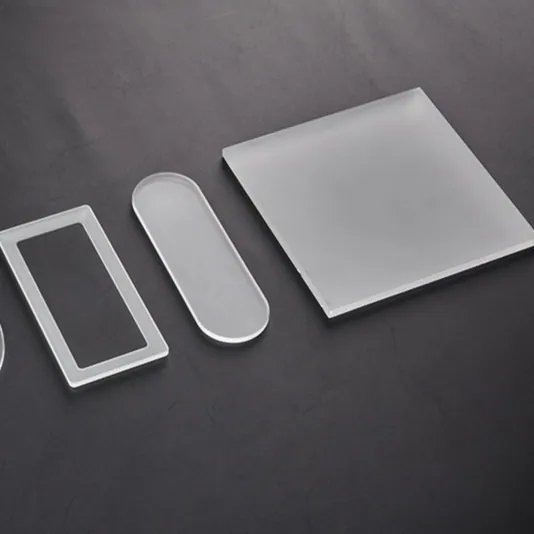
Optical Glass Cold Processing in Ultra-Thin Glass Strengthening
Before chemical strengthening the glass has to arrive flat, clean-edged and dimensionally controlled, because the ion-exchange step magnifies whatever stress raiser the edge already carries. Cold processing here means precision grinding to thickness, polishing the surfaces, and edge profiling so the part does not crack at the touch of the strengthening bath. The comparison is really about how much edge and surface quality you buy up front versus how many parts you lose downstream.
Substrate and material selection
The glass family decides how it behaves under thinning: alkali-aluminosilicate sheets take chemical strengthening well but are unforgiving of edge defects, while some display-grade glasses are easier to polish but less tolerant of deep ion exchange. The substrate choice also sets the allowable removal rate, because a soft glass loads the wheel faster and a hard one needs a finer sequence. Pick the material for the strengthening route first, then tune the cold process to it rather than the other way round.
What drives cost and lead time
Cost is dominated by the number of grinding and polishing steps and by yield, because a single edge micro-crack that survives processing can fail the part weeks later. Lead time tracks the iteration needed to hold thickness and flatness on a fragile, thin blank, which is slower than the same work on thick stock. Specifying a surface and edge quality the process can hold routinely, rather than the best number on the chart, is what keeps price and schedule realistic.
The tolerances that actually matter
For thin glass the edge quality and thickness uniformity matter more than the surface figure, because the edge is where strengthening-induced stress concentrates and where cracks start. Flatness still matters where the part seats against a display or sensor, but a sub-micron surface finish only pays off if the application reads it. The tolerances that move yield are the ones on the edge and on thickness variation, not the generic optical polish limits.
How it compares with the alternatives
Mechanical grinding and polishing gives the best edge control and the most predictable strengthening outcome but costs the most steps, while a lighter grinding-only route is cheaper and faster but leans harder on the strengthening bath to forgive edge defects. Skipping edge work to save a step usually shows up later as a higher breakage rate that costs more than the step would have. The right route is the cheapest one whose edge quality still clears the strengthening yield target.
Requirements specific to Ultra-Thin Glass Strengthening
Strengthening duty adds an ion-exchange bath that magnifies any edge defect, so edge quality and thickness uniformity lead the cold-processing specification. Choose the substrate for the strengthening route, grind and polish the edge to a defect-free profile, and hold thickness variation tight so the bath stresses the part evenly. Require an edge inspection step rather than a visual pass, because a micro-crack that survives processing can fail the part after it ships.
- Substrate chosen for strengthening route
- Edge profiled defect-free
- Thickness uniform across blank
- Surface finish matched to use
- Edge inspection, not visual only
- Yield target sets process depth
Framework references: edge, surface and thickness limits per ISO 10110. The strengthening process and its acceptance are the downstream step's to qualify; cold processing supplies the blank quality those steps assume.
Selection data at a glance
| Parameter | Typical capability | Notes |
|---|---|---|
| Substrate | Alkali-aluminosilicate | Per route |
| Grind | To thickness | Blank |
| Polish | Surface, edge | Quality |
| Edge | Profiled, inspected | Yield |
| Thickness | Uniform | Bath stress |
| Inspection | Edge scan | Ship |
Frequently asked questions
Can we skip edge polishing to save a step?
Only if the strengthening yield still clears target, and in practice it usually does not. The ion-exchange bath magnifies whatever edge defect is already there, so a missed micro-crack tends to fail the part later rather than during processing, which costs more than the step would have.
Does the glass family change the cold process?
Yes. Some glasses are easy to polish but weak under deep ion exchange, others strengthen well but are unforgiving of edge defects. Choose the material for the strengthening route first, then tune the grinding and polishing sequence to it.
What tolerance matters most for yield?
Edge quality and thickness uniformity, because the edge is where strengthening stress concentrates and where cracks start, and thickness variation makes the bath stress the part unevenly. A tight surface figure only pays off if the application actually reads it.
Need a quotation for optical glass cold processing?
Send your drawing, target specification or coating requirement and an optical engineer will reply within 24 hours with a price and a lead time.
Request a Quote Email an engineer