Requirements in aerospace and defense optics have been shifting - thinner parts, wider bands, harsher environments - and those shifts change what coated color filter glass suppliers are being asked to hold. This article reviews where the demand is heading, what it means for specifications, and how to structure sourcing so that a design is not locked to a single process.
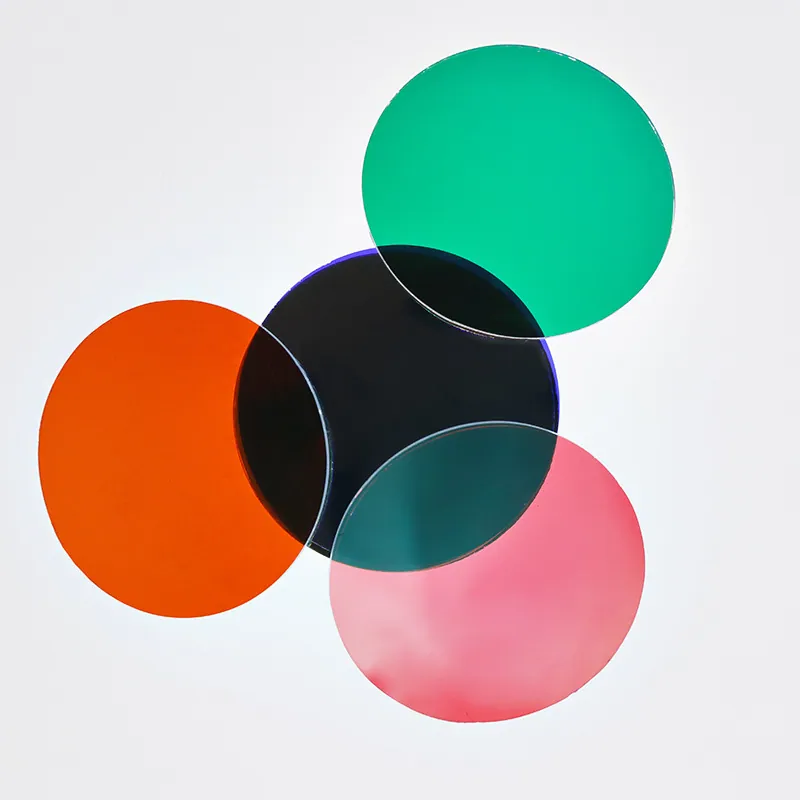
Coated Color Filters in Aerospace and Defense Optics
In aerospace and defense optics, that translates into a specific set of requirements rather than a general preference for quality. Aerospace optics are qualified against thermal vacuum, vibration, shock and radiation environments, and once qualified they are difficult to change, which makes documentation and reproducibility the dominant requirement. Weight is critical, coatings must survive without moisture uptake, and every part carries a certification trail.
How coated color filter glass works in practice
A coated color filter produces its color by interference rather than by absorbing dyes, and that distinction decides everything else about the part. A stack of alternating high- and low-index layers, usually a few dozen layers thick, reflects the wavelengths it must suppress and transmits the band the design calls for. Because nothing is bleached or burned out, the color does not fade with lamp hours, which is why coated color plates dominate in Aerospace and Defense Optics where the filter sits in front of a high-intensity source. The same physics allows a single coating run to place different colors on different zones of one plate, print a logo in a defined color, or produce a dichroic edge that reflects one band while passing another. The limiting factor is angular sensitivity: the passband shifts toward shorter wavelengths as the angle of incidence increases, so a design is only as good as the acceptance angle it was specified for.
Design rules that reduce cost
Designing with coated color filters is mostly about angle, heat and mounting. Decide the acceptance cone first: a narrow cone buys a steeper edge and purer color, a wide cone buys luminous efficiency at the cost of color saturation. Then decide how the part is retained - a ring, clips, adhesive or a frame - and leave a margin of at least 1 mm that carries no coating so the retention never touches an optical surface. Keep patterned areas at least 0.3 mm from the edge for the same reason. If the part sits behind a condenser or a lens, model the angular spread rather than assuming collimated light, because the effective spectrum will be a weighted average over that spread. For Aerospace and Defense Optics, a short note on the drawing stating the acceptance angle, the mounting method and the maximum flux prevents most of the arguments that otherwise surface at first article.
Standards, documentation and traceability
Color filters are governed by a mix of optical, safety and environmental requirements. Drawings follow ISO 10110 for surface form and imperfections; transmissions are reported against CIE color coordinates when the customer specifies a color target rather than a spectrum. Environmental compliance means RoHS and REACH declarations, and for stage and entertainment products there are additional considerations around fire behavior and photobiological safety of the light source itself. In Aerospace and Defense Optics, the documents that hold up a shipment are typically the photometric report, the material declaration and, increasingly, a substance report confirming the absence of restricted dyes. Because a coated filter contains no organic colorant, this is straightforward - but the paperwork still has to exist before the goods clear.
What drives cost and lead time
The price of a coated color filter is mostly a function of the number of layers, the size of the substrate and the yield of the coating run. A 20-layer color coating is routine; a 60-layer edge filter with a 2 nm transition costs several times more because the chamber time and the sensitivity to thickness error both rise sharply. Patterned parts add a lithography or screen-printing step whose cost is dominated by the mask or screen, so the first piece is expensive and the hundredth is not. Substrate grade and thickness contribute less than most buyers expect; the real cost jumps come from tight spectral tolerances, from parts larger than the chamber's uniform zone, and from low volumes that force a chamber to be run for a handful of plates. Consolidating colors that can share one run is the single most effective cost reduction in Aerospace and Defense Optics.
Inspection and measurement
Every color filter should ship with a measured curve, not a nominal one. Spectrophotometry from 350 to 1050 nm at the specified angle of incidence is the baseline; for parts used in laser or high-flux systems, laser damage threshold data and a transmission map across the aperture are worth requesting. Color coordinates, where the customer specifies them, need a defined illuminant and observer, and they must be measured on the actual part rather than predicted from the design. In Aerospace and Defense Optics, the incoming inspection that catches the most escapes is a physical check of the patterned areas and the edge quality, because a coating can be spectrally perfect and still be rejected for a chip or a registration error that a bench measurement never sees.
Requirements specific to Aerospace and Defense Optics
In aerospace and defense optics, that translates into a specific set of requirements rather than a general preference for quality. Aerospace optics are qualified against thermal vacuum, vibration, shock and radiation environments, and once qualified they are difficult to change, which makes documentation and reproducibility the dominant requirement. Weight is critical, coatings must survive without moisture uptake, and every part carries a certification trail.
- Thermal vacuum and vibration survival
- Low weight with high specific stiffness
- Coating stability with no moisture shift
- Full first-article and process documentation
AS9100 quality systems, MIL specifications for coatings and surface quality, and customer-specific environmental qualification protocols.
Selection data at a glance
| Parameter | Typical value | Notes |
|---|---|---|
| Dominant wavelength | 450-660 nm, custom to ±5 nm | Per color chip |
| Transmission in band | >= 85 % (T>= 90 % on tuned designs) | At normal incidence |
| Out-of-band blocking | OD2 - OD4 | Visible to NIR |
| Coating type | IAD multilayer hard oxide | Color-by-interference |
| Substrate | B270, borosilicate, ultra-clear, quartz | Heat-resistant grades for high flux |
| Thickness | 0.3-3 mm | 1.1 mm typical for gobos |
| Size tolerance | ±0.1 mm, ±0.05 mm on request | Round, square, custom outline |
| Pattern tolerance | ±0.05 mm registration | Screen print, lithography or mask |
| Operating temperature | up to 400 °C substrate dependent | Thermal shock is the real limit |
Frequently asked questions
How much does a coated color filter shift with angle?
A typical visible-band stack shifts toward shorter wavelengths by roughly 1 % of the wavelength for every 10 degrees of incidence. A design specified for 0 degrees and used in a 30 degree cone will therefore read noticeably bluer than the nominal curve, which is why the acceptance angle belongs on the drawing.
Can you print a logo or pattern in a specific color?
Yes. Patterns are produced by masking or lithography before coating, or by screen printing a patterned layer, with registration typically held to ±0.05 mm. Keep features at least 0.3 mm from the edge and provide artwork as vector data.
Will the color fade over time?
No. Interference coatings are inorganic hard oxide layers; there is no dye to bleach. Color changes in the field almost always come from a humid coating deposited without ion assistance, or from a design that was specified for a lower operating temperature than the application reached.
Need a quotation for coated color filters?
Send your drawing, target specification or coating requirement and an optical engineer will reply within 24 hours with a price and a lead time.
Request a Quote Email an engineer