Specifying coated color filter glass for agricultural sensing and crop monitoring is largely a matter of deciding which three numbers actually govern the application and letting the rest follow. This guide walks through the parameters that belong on the drawing, the tolerances that genuinely change the price, and the specification items that are routinely left out and then argued about at first article.
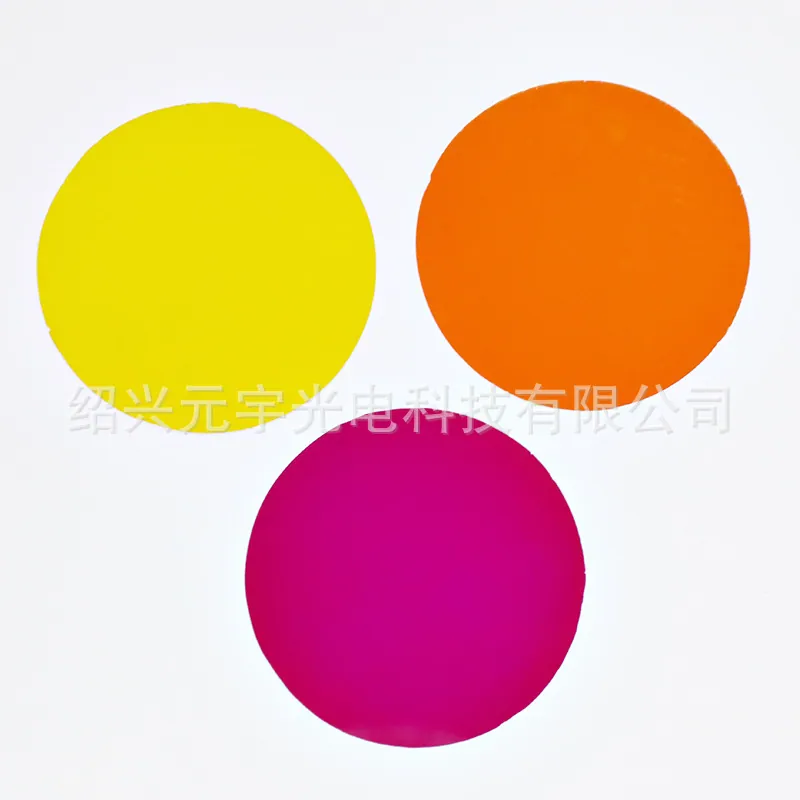
Coated Color Filters in Agricultural Sensing and Crop Monitoring
In agricultural sensing and crop monitoring, that translates into a specific set of requirements rather than a general preference for quality. Agricultural optics live outdoors for a full season or more, exposed to ultraviolet, dust, irrigation spray and temperature swings, and they are usually deployed in numbers large enough that maintenance is impractical. Multispectral and NDVI instruments also depend on precise band separation, because the vegetative index is computed from narrow wavelength differences.
The tolerances that actually matter
Color work has two tolerance systems that must be quoted together. The spectral tolerance defines how far the transition or the dominant wavelength may sit from nominal - typically ±5 nm for a color chip and ±2 nm for an interference edge used in a measurement path. The geometric tolerance defines where the color sits on the plate, which matters for gobos, patterned filters and multi-zone parts. Add a photometric tolerance for transmission: a filter quoted at 90 % transmission that ships at 82 % is a different color to the eye. In Agricultural Sensing and Crop Monitoring, also fix the angle of incidence at which the numbers are valid, because a coating designed for 0 degrees and measured at 15 degrees will read several nanometers short of nominal and the customer will call it off-spec even though nothing is wrong.
Design rules that reduce cost
Designing with coated color filters is mostly about angle, heat and mounting. Decide the acceptance cone first: a narrow cone buys a steeper edge and purer color, a wide cone buys luminous efficiency at the cost of color saturation. Then decide how the part is retained - a ring, clips, adhesive or a frame - and leave a margin of at least 1 mm that carries no coating so the retention never touches an optical surface. Keep patterned areas at least 0.3 mm from the edge for the same reason. If the part sits behind a condenser or a lens, model the angular spread rather than assuming collimated light, because the effective spectrum will be a weighted average over that spread. For Agricultural Sensing and Crop Monitoring, a short note on the drawing stating the acceptance angle, the mounting method and the maximum flux prevents most of the arguments that otherwise surface at first article.
Coating and deposition considerations
The coating design is where the color is actually made. Interference stacks are built from alternating layers of materials such as Nb2O5, Ta2O5 or TiO2 against SiO2, and the layer count and thickness ratio tune the reflection band, the transition steepness and the ripple in the passband. IAD or another ion-assisted process is preferred because it produces dense, hard oxide layers with little moisture shift, so the color does not move when humidity changes. Because the shift with angle is intrinsic, multi-zone filters are designed so that each zone has its own stack and its own angular window. For Agricultural Sensing and Crop Monitoring, decide early whether the part needs a hard coat on both faces (scratch resistance and second-surface reflection control) or a single coated face, and whether any area must remain uncoated for a sensor or a bond line.
How coated color filter glass works in practice
A coated color filter produces its color by interference rather than by absorbing dyes, and that distinction decides everything else about the part. A stack of alternating high- and low-index layers, usually a few dozen layers thick, reflects the wavelengths it must suppress and transmits the band the design calls for. Because nothing is bleached or burned out, the color does not fade with lamp hours, which is why coated color plates dominate in Agricultural Sensing and Crop Monitoring where the filter sits in front of a high-intensity source. The same physics allows a single coating run to place different colors on different zones of one plate, print a logo in a defined color, or produce a dichroic edge that reflects one band while passing another. The limiting factor is angular sensitivity: the passband shifts toward shorter wavelengths as the angle of incidence increases, so a design is only as good as the acceptance angle it was specified for.
Requirements specific to Agricultural Sensing and Crop Monitoring
In agricultural sensing and crop monitoring, that translates into a specific set of requirements rather than a general preference for quality. Agricultural optics live outdoors for a full season or more, exposed to ultraviolet, dust, irrigation spray and temperature swings, and they are usually deployed in numbers large enough that maintenance is impractical. Multispectral and NDVI instruments also depend on precise band separation, because the vegetative index is computed from narrow wavelength differences.
- UV-stable coatings for multi-season exposure
- Precise narrow-band definition for vegetation indices
- Hydrophobic surface to shed dew and spray
- Low power consumption for remote installations
IP-rated enclosure compatibility, ISO 10110 drawings, and RoHS and REACH declarations.
Selection data at a glance
| Parameter | Typical value | Notes |
|---|---|---|
| Dominant wavelength | 450-660 nm, custom to ±5 nm | Per color chip |
| Transmission in band | >= 85 % (T>= 90 % on tuned designs) | At normal incidence |
| Out-of-band blocking | OD2 - OD4 | Visible to NIR |
| Coating type | IAD multilayer hard oxide | Color-by-interference |
| Substrate | B270, borosilicate, ultra-clear, quartz | Heat-resistant grades for high flux |
| Thickness | 0.3-3 mm | 1.1 mm typical for gobos |
| Size tolerance | ±0.1 mm, ±0.05 mm on request | Round, square, custom outline |
| Pattern tolerance | ±0.05 mm registration | Screen print, lithography or mask |
| Operating temperature | up to 400 °C substrate dependent | Thermal shock is the real limit |
Frequently asked questions
Can you print a logo or pattern in a specific color?
Yes. Patterns are produced by masking or lithography before coating, or by screen printing a patterned layer, with registration typically held to ±0.05 mm. Keep features at least 0.3 mm from the edge and provide artwork as vector data.
Will the color fade over time?
No. Interference coatings are inorganic hard oxide layers; there is no dye to bleach. Color changes in the field almost always come from a humid coating deposited without ion assistance, or from a design that was specified for a lower operating temperature than the application reached.
What substrate should I use for a high-power lighting fixture?
Borosilicate or a dedicated heat-resistant glass for most fixtures, and fused silica or a low-expansion substrate when the part experiences rapid thermal cycling. Thin substrates survive thermal shock better than thick ones because the gradient across the plate is smaller.
Need a quotation for coated color filters?
Send your drawing, target specification or coating requirement and an optical engineer will reply within 24 hours with a price and a lead time.
Request a Quote Email an engineer