Smart-city sensing, from intersection monitoring to air-quality and perimeter detection, uses infrared filters to reject the dense urban ambient and keep the signal it supplies. Deployment is moving toward narrower bands, higher out-of-band rejection and multi-spectral stacks that serve several channels at once. This note covers the sourcing trends, the documentation that matters, and the trade-offs that actually move cost and lead time.
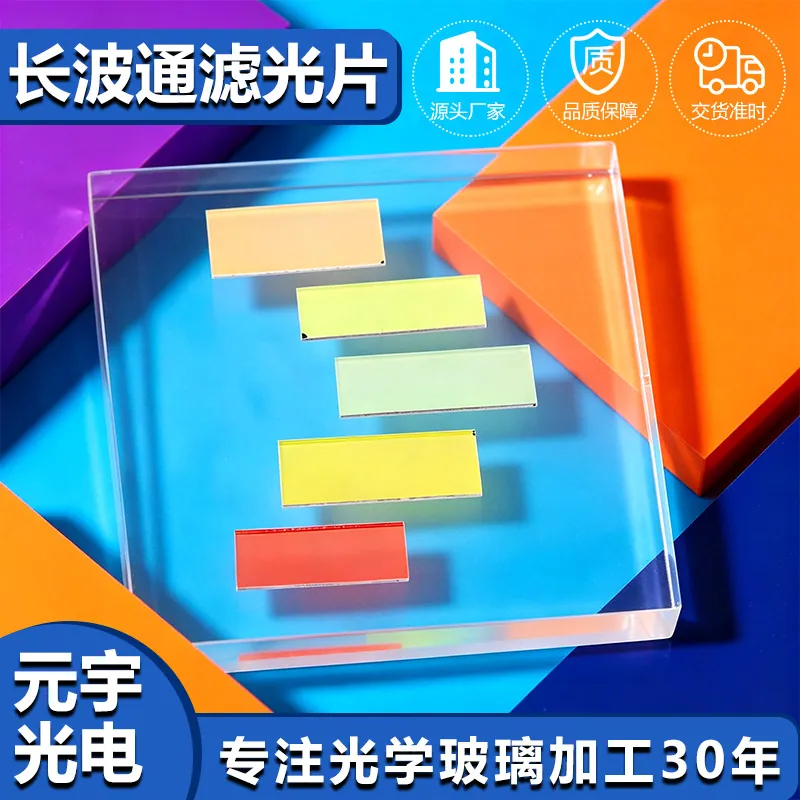
IR Filters in Smart City and Intelligent Transport
In smart-city sensing the filter sits in front of a camera or a photodetector that is lit by a controlled source, an illuminator, a flame or a thermal signature, and the city around it throws broadband light from street lamps, signage and headlights. The filter's job is to pass the signal band and reject that ambient so the sensor reads what the system supplied rather than the city's glow. Because the units are deployed in large numbers and in harsh spots, the filter has to be both spectrally tight and cheap to field in volume.
What drives cost and lead time
Cost and lead time are driven by layer count, bandwidth and substrate. A narrower band or a steeper edge needs more layers and a longer deposition; a custom centre wavelength costs more than a catalogue one; and a small order of a special glass extends lead time well beyond the coating step. Multi-spectral stacks that serve several channels on one substrate can reduce total cost at volume even though each part is more complex, because they replace several single-band filters.
How IR filters works in practice
A band-pass filter passes the signal wavelength and blocks the rest, so the sensor mainly sees light the system itself supplied. On a smart-city node the useful signal is often a narrow band against a broadband city, so the rejection curve, not the peak transmission, decides the image or count quality. The band also shifts with angle on a wide field and with temperature across a day outdoors, so the design needs margin at both extremes or the corners or the hot hours go soft.
Design rules that reduce cost
Two rules remove most avoidable cost. The first is to specify only the band the source actually uses rather than an ultra-narrow pass that forces extra layers; the second is to relax non-critical tolerances such as cosmetic surface grade where the aperture is small. Standard substrate sizes, a durable hard coat and a shared band set across a node family keep volume up and lead time down, while a multi-spectral design consolidates channels instead of multiplying single filters.
Standards, documentation and traceability
Surface and flatness tolerances for the filter substrate are generally stated in ISO 10110, and a spectral transmission certificate per lot lets a node be re-qualified after a filter change. RoHS and REACH status should be stated by the supplier against the current official text, and for transport-adjacent deployment the relevant framework documentation supports the audit. Keeping the spectral curve with the part means a replacement reproduces the original rejection.
Requirements specific to Smart City and Intelligent Transport
Smart-city and transport applications add dense urban ambient, wide-angle lenses and seasonal temperature swing to the usual filter specification. Require continuous out-of-band blocking against street lighting and headlights, budget a shift margin for the lens angle and the operating temperature, and seal the part for outdoor duty. Where several channels share one node, consider a multi-spectral stack that consolidates the bands and keeps calibration per lot.
- Continuous out-of-band blocking against urban ambient
- Shift margin for lens angle and temperature
- Sealed, outdoor-durable hard coating
- Standard band set or multi-spectral consolidation
- Per-lot spectral curve for field re-qualification
Framework references: surface and flatness tolerances for the filter substrate are generally stated in ISO 10110; environmental qualification should follow the applicable outdoor or transport equipment rule set. RoHS and REACH declarations are the supplier's to state against the current official text, not to be assumed.
Selection data at a glance
| Parameter | Typical value | Notes |
|---|---|---|
| Band | Only what source uses | Avoid over-narrow |
| Blocking | Continuous, broadband | Urban ambient |
| Shift | Angle and temperature | Outdoor margin |
| Coating | Hard, sealed | Weather duty |
| Traceability | Per-lot spectral | Re-qualify |
Frequently asked questions
Why specify blocking as a curve for a city node?
Because urban ambient is broadband, from street lamps to signage to headlights. A filter that blocks one measured point but leaks elsewhere will still let the city's glow wash the signal, so a continuous rejection curve across the band is what keeps the node reading what it supplied.
Is a multi-spectral filter worth the complexity?
At volume, often yes. A single substrate serving several channels replaces several single-band filters and can lower total cost even though each part is more complex, while also simplifying the bill of materials and the field replacement. For a small pilot, separate filters may be simpler to source.
Does temperature really move the band enough to matter outdoors?
It does over a day in the field. The dielectric stack expands and contracts with temperature, shifting the centre wavelength, and a node in direct sun runs warm. Without a shift margin designed in, the corners of the frame or the hot hours can drift off-band even when the bench measurement looked perfect.
Need a quotation for ir filters?
Send your drawing, target specification or coating requirement and an optical engineer will reply within 24 hours with a price and a lead time.
Request a Quote Email an engineer