Short-wave infrared imaging needs band-pass and long-pass filters tuned to the SWIR window where InGaAs sensors read and where silicon goes blind, and the filter choice decides whether a surveillance or inspection camera sees through haze, foliage or glass. As SWIR sensors get cheaper the filter is being specified more as a production component and less as a lab item. This comparison weighs the filter routes and where each one earns its place for SWIR imaging and surveillance.
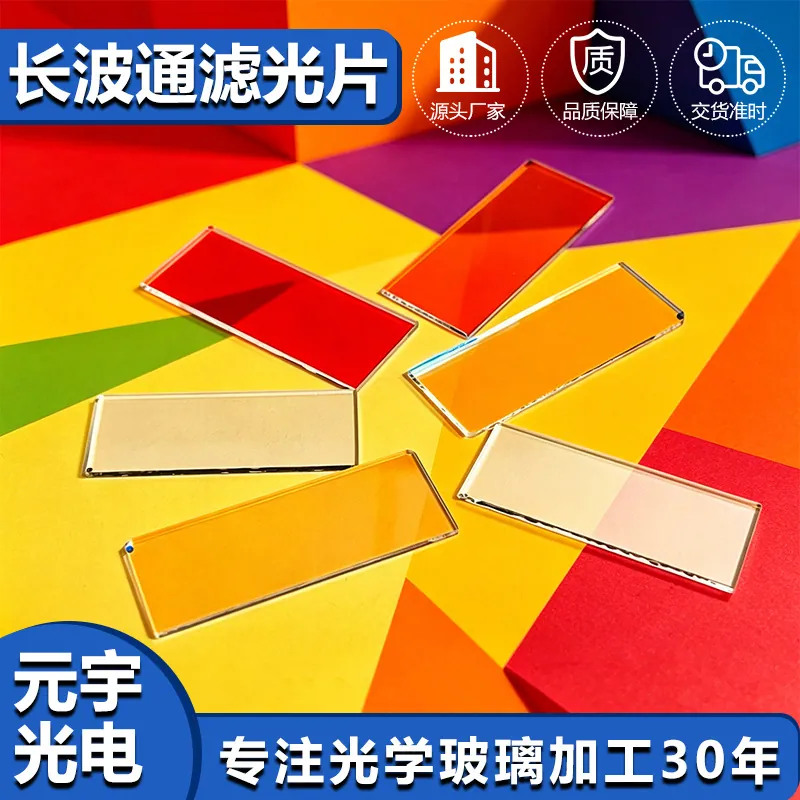
IR Filters in SWIR Imaging and Surveillance
In a SWIR camera the filter defines the band the sensor is allowed to see, isolating the atmospheric window where the scene is bright and the sensor is responsive while blocking the visible and thermal bands that add noise. The filter is what turns a raw InGaAs die into a useful imager, and its edge steepness and out-of-band blocking decide whether the camera penetrates haze or just sees glare. The comparison is about how much blocking and edge control the application actually pays for.
Substrate and material selection
The substrate has to transmit the SWIR band, so sapphire, certain glasses or special IR materials are chosen over ordinary visible glass that absorbs there. The coating is a multi-layer stack whose layer count sets the edge steepness and the blocking depth, and a harder substrate lets the part survive outdoor duty. Pick the substrate for the band and the environment first, then size the coating to the blocking the camera needs.
What drives cost and lead time
Cost is driven by the number of coating layers and by the blocking depth, because a steep edge and deep out-of-band rejection need more layers and tighter control. Lead time tracks the coating runs needed to hit those edges, which is longer than for a simple visible filter. Specifying the band and rejection only as tightly as the sensor needs keeps both price and schedule realistic.
The tolerances that actually matter
For a SWIR filter the band edges and out-of-band blocking matter more than the surface figure, because a shifted edge lets in the visible glare the camera cannot use and a shallow block lets noise through. Uniformity across the aperture matters where the filter covers a wide field, but the dominant risks are spectral, not geometric. The tolerances that move image quality are the ones on the edges and the rejection, not the catalogue flatness number.
How it compares with the alternatives
A band-pass stack gives the tightest isolation for a specific SWIR window but costs the most layers, while a long-pass filter is cheaper and broader and suits surveillance that just wants to reject visible. An absorptive glass alternative is robust and cheap but cannot give a steep edge. The right filter is the cheapest one whose band and blocking still clear the camera's signal-to-noise target.
Requirements specific to SWIR Imaging and Surveillance
Surveillance duty adds an outdoor environment and a signal-to-noise target to the usual optical constraints, so band-edge control, out-of-band blocking and substrate hardness lead the specification. Choose a SWIR-transmitting, durable substrate, size the coating layers to the blocking the sensor needs, and control edge uniformity across the aperture. Require a spectrophotometer sweep of the band and the rejection rather than a certificate value, because a SWIR camera has to reject visible glare as well as it passes its own window.
- SWIR-transmitting substrate
- Band edges set to sensor
- Out-of-band blocking sized
- Edge uniform across aperture
- Hard substrate for outdoor
- Spectro sweep of band
Framework references: coating and spectral limits per ISO 10110 and relevant optical-filter guidance. Environmental declarations such as RoHS are the supplier's to state against the current official text.
Selection data at a glance
| Parameter | Typical value | Notes |
|---|---|---|
| Substrate | SWIR-transmitting | Band |
| Coating | Band-pass stack | Edges |
| Blocking | Out-of-band | Rejection |
| Uniformity | Across aperture | Field |
| Hardness | Outdoor grade | Survive |
| Check | Spectro sweep | Band |
Frequently asked questions
Why not just use a long-pass filter for surveillance?
Because a long-pass is cheap and rejects visible, but it lets the whole SWIR band through including the parts your sensor does not need, which adds background. A band-pass gives tighter isolation for a specific window at the cost of more coating layers, so the choice is about the camera's noise target.
Why does the substrate matter in SWIR?
Because ordinary visible glass absorbs in the SWIR, so the filter has to be on a substrate that transmits the band in the first place, and a harder substrate also survives outdoor duty where a soft one would not.
What tolerance matters most for image quality?
The band edges and the out-of-band blocking, because a shifted edge lets in visible glare the sensor cannot use and a shallow block lets noise through. Surface figure is secondary unless the filter sits in a converging beam.
Need a quotation for ir filters?
Send your drawing, target specification or coating requirement and an optical engineer will reply within 24 hours with a price and a lead time.
Request a Quote Email an engineer