Automatic number-plate recognition and traffic-enforcement cameras image licence plates under dedicated infrared illuminators, often against street lighting and headlights. The filter in front of the sensor has one job above all others: pass the illuminator wavelength and reject everything else, so the plate stays high-contrast regardless of the ambient. This guide sets out the numbers that belong on the drawing and the ones that only matter once the camera is mounted at the roadside.
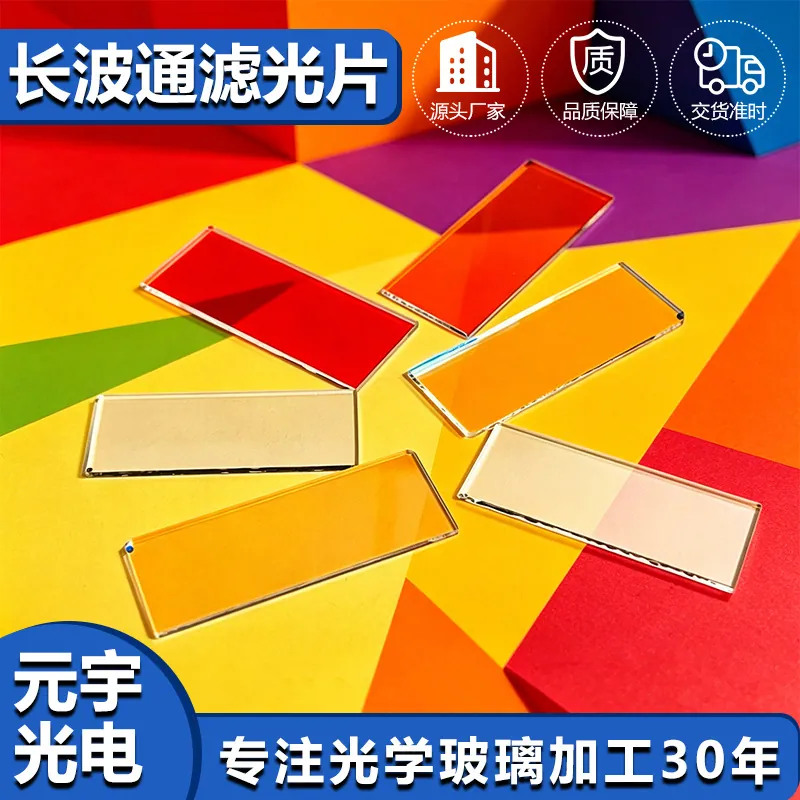
IR Filters in Traffic Enforcement and ANPR
ANPR and enforcement optics pair an infrared illuminator with a camera fitted with a narrow band-pass filter centred on that illuminator. The plate is printed with retroreflective characters that return the illuminator light efficiently, while the filter suppresses the visible and thermal background that would otherwise wash the image out. The filter therefore defines the signal-to-background of the whole system, and a mismatch to the illuminator is the most common reason a theoretically good camera reads poorly in the field.
The tolerances that actually matter
For an enforcement filter the useful numbers are centre wavelength and its tolerance against the illuminator, full width at half maximum, peak transmission, and out-of-band blocking across both the visible and the short-wave infrared. Just as important are the shifts the installation induces: the centre wavelength moves with angle of incidence on a wide-angle lens and with temperature across a season of outdoor duty. A design that ignores those shifts ends up off-band at the corners of the frame or in summer, even if the centre of the pass is correct on the bench.
Design rules that reduce cost
Two decisions dominate cost without hurting performance. The first is to specify only the band the illuminator actually uses rather than an ultra-narrow pass that forces more layers; the second is to avoid sub-angstrom centre-wavelength tolerances that demand tighter deposition control than the application needs. Standard substrate thickness, a surface quality grade that matches the aperture rather than a precision-optics grade, and a monolithic hard coating instead of a cemented stack all reduce cost while keeping the rejection the roadside needs.
Coating and deposition considerations
An enforcement filter is a hard multilayer dielectric stack that selects the band by interference and rejects the rest with a sequence of blocking layers. The difference from a bench filter is the environmental regime: the coating has to survive humidity, temperature cycling and constant vibration on a pole or gantry. Ion-assisted or similar dense deposition improves environmental stability, and the blocking should be specified as a continuous rejection curve, not a single off-band point, because street lighting and headlights are broadband.
How IR filters works in practice
A band-pass filter passes the illuminator wavelength and blocks the rest, so the sensor mainly sees light the system itself supplied. On a plate lit by an 850 nm or 940 nm illuminator, a filter centred there with strong visible blocking turns a cluttered night scene into a clean plate image. The catch is shift: as the lens angle grows toward the frame edge, the centre wavelength drifts, and as the housing heats through the day the stack expands and the band moves, so the design needs margin at both extremes or the corners or the hot hours go soft.
Requirements specific to Traffic Enforcement and ANPR
ANPR and enforcement applications add roadside ambient, wide-angle lenses and seasonal temperature swing to the usual filter specification. Match the centre wavelength to the actual illuminator rather than to a generic near-infrared band, require continuous out-of-band blocking against street lighting and headlights, and budget a shift margin for the lens angle and the operating temperature. Seal the part for outdoor duty and keep a spectral curve per lot so a replacement camera head reproduces the original read performance.
- Centre wavelength matched to the illuminator, not generic NIR
- Continuous out-of-band blocking against street light and headlights
- Shift margin for lens angle and operating temperature
- Hard coating qualified for humidity, vibration and thermal cycle
- Per-lot spectral curve for field replacement
Framework references: surface and flatness tolerances for the filter substrate are generally stated in ISO 10110; environmental qualification should follow the applicable roadside or transport equipment rule set. RoHS and REACH declarations depend on the coating stack and are the supplier's to state against the current official text, not to be assumed.
Selection data at a glance
| Parameter | Typical value | Notes |
|---|---|---|
| Centre wavelength | Matched to illuminator | e.g. 850 / 940 nm |
| Bandwidth (FWHM) | Per illuminator need | Avoid over-narrow |
| Visible blocking | Strong continuous | Street light reject |
| Angle shift | Budgeted at frame edge | Wide-angle lens |
| Temperature shift | Budgeted over season | Outdoor duty |
| Environment | Humidity, vibration, cycle | Pole or gantry |
Frequently asked questions
Should the filter centre wavelength match the illuminator exactly?
Yes, as closely as the budget allows. The filter and the illuminator are a pair; a centre wavelength that drifts away from the illuminator throws away the very light the system supplied and leaves the ambient it was meant to block. Specify the illuminator wavelength on the drawing rather than a generic near-infrared band.
Why specify blocking as a curve instead of one off-band point?
Because roadside ambient is broadband. Street lighting, signage and headlights cover a wide range, and a filter that blocks one measured point but leaks elsewhere will still wash the plate. A continuous rejection curve across the visible and short-wave infrared is what keeps the image clean.
Does temperature really move the band enough to matter?
It does over a season outdoors. The dielectric stack expands and contracts with temperature, shifting the centre wavelength, and a camera head in direct sun runs warm. Without a shift margin designed in, the corners of the frame or the hot hours of the day can drift off-band even when the bench measurement looked perfect.
Need a quotation for ir filters?
Send your drawing, target specification or coating requirement and an optical engineer will reply within 24 hours with a price and a lead time.
Request a Quote Email an engineer