Volcanic plumes and gas seeps along fault zones are composed of a few infrared-active species - sulphur dioxide, carbon dioxide, hydrogen sulphide and water - each with its own absorption lines in the mid-infrared. A ground or airborne gas sensor reads those lines through an infrared filter that isolates a target band while rejecting the rest. The filter's substrate and band shape decide sensitivity, cross-talk and field ruggedness, so the choice is a physics trade, not a catalogue pick. This comparison lines up the substrate and filter options for volcanic and seismic-gas monitoring.
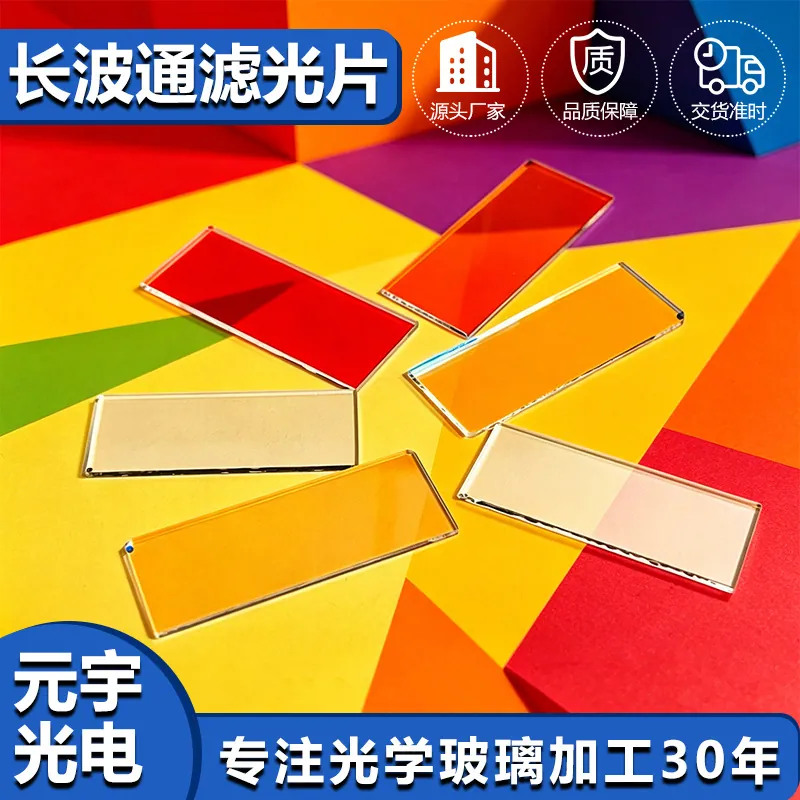
IR Filters in Volcanic and Seismic Gas Monitoring
A volcanic-gas sensor typically measures several species at once, each at a distinct mid-infrared wavelength, so the optical head carries a set of narrow bandpass filters - often on a rotating wheel or behind a selector - that step through the target lines. For sulphur dioxide the band sits near 7.3 micrometres, carbon dioxide near 4.3 micrometres, and water vapour has broad structure across the band, so the filter set has to separate the target line from neighbouring water and from other plume species. The sensor may be a fixed station near a vent or a portable unit carried on a survey, which means the filters must hold their band in heat, dust and vibration while staying small and low-power.
Substrate and material selection
The substrate is set by the wavelength. Silicon and germanium cover the near- and short-wave infrared well and are cheap and robust, but germanium is opaque past about 1.8 micrometres and both stop before the long-wave bands some species need. For the mid-infrared bands of SO2 and CO2, zinc selenide, sapphire or chalcogenide glass are the usual substrates, with chalcogenide reaching further into the long-wave infrared at the cost of softer hardness. The substrate must also survive the field: a vent-side instrument sees acid aerosol and heat, so chemical durability and a protective coating matter as much as transmission. Selection is therefore a balance of band coverage, hardness and chemical resistance rather than a single best window.
What drives cost and lead time
Cost is driven by band narrowness and by how many lines the set must cover. A single broad NDIR filter is cheap; a matched set of narrow bandpasses tuned to several gas lines, especially in the long-wave infrared on chalcogenide or zinc selenide, costs more and takes longer because each layer must be held to hold the centre wavelength. Lead time grows when the bands are custom to a specific instrument or when the substrate is a long-wave material that few coaters run. Standard near-infrared silicon-based filters ship quickly; custom mid-infrared sets and environmentally sealed assemblies add weeks. The economical route is to standardise on the few gas lines the mission needs and buy a matched set rather than designing each channel alone.
The tolerances that actually matter
The numbers that move sensitivity are centre wavelength, bandwidth and out-of-band blocking. A shift in centre wavelength moves the band off the absorption line and directly cuts signal; too wide a bandwidth lets neighbouring water vapour or another species leak in and biases the reading. Blocking outside the band decides cross-talk between channels. Mechanically, the tolerances that matter are wedge and flatness where the filter sits in a collimated beam, and surface quality where scatter couples into the detector. For a field unit, environmental stability of the band with temperature is also a real tolerance, because a filter whose centre drifts with heat will read wrong on a hot vent.
How it compares with the alternatives
Against a broadband NDIR filter, a narrow bandpass gives far better species selectivity but needs more filters to cover several gases and is more sensitive to centre-wavelength error. Against a gas-filter-correlation wheel, the fixed bandpass is simpler and cheaper but cannot confirm a line shape the way correlation can. Against an interferometric or laser spectrometer, the filtered sensor is lower cost and lower power but coarser in resolution. For volcanic and seismic-gas survey work the filtered multi-band sensor is usually the pragmatic choice: enough selectivity for the main species, rugged and field-portable, with the band set tuned to the lines that actually matter for the plume or seep being monitored.
Requirements specific to Volcanic and Seismic Gas Monitoring
The field is the hard part: a vent-side unit sees acid aerosol, heat and vibration, and a survey unit is carried and knocked about, so the filter substrate needs chemical durability and a protective coating, and the band needs to stay put with temperature. The other point is that plumes contain several overlapping species, so the filter set is designed to separate the target lines from water and neighbours, not to maximise raw transmission. Specify the exact gas lines and the operating temperature range, and confirm the blocking against the strongest interfering band rather than to an absolute floor.
- Substrate follows the wavelength: Si/Ge near-IR, ZnSe/sapphire/chalcogenide mid-IR
- Centre wavelength and bandwidth decide sensitivity and species cross-talk
- Field units need chemically durable substrates and temperature-stable bands
- A matched narrow-band set beats a single broadband filter for multi-species plumes
Framework references: filter acceptance is against the measured spectral curve; optical element tolerances follow ISO 10110 where the part is dimensioned. Gas absorption lines are set by molecular spectroscopy; confirm the target wavelengths against the current instrument design rather than a generic band name.
Selection data at a glance
| Parameter | Typical value | Notes |
|---|---|---|
| Target species | SO2 ~7.3 um, CO2 ~4.3 um, H2S, H2O | Sets the band |
| Substrate | Si/Ge near-IR; ZnSe/sapphire/chalcogenide mid-IR | Per wavelength |
| Centre wavelength | matched to absorption line | Off-line cuts signal |
| Bandwidth | narrow for selectivity | Controls cross-talk |
| Out-of-band blocking | deep at water / neighbour lines | Per plume mix |
| Field durability | acid, heat, vibration rated | Vent-side units |
Frequently asked questions
Why not just use one broadband filter?
Because a plume contains several overlapping infrared species, especially water. A broadband NDIR filter cannot separate sulphur dioxide from water or carbon dioxide well enough; a set of narrow bandpasses tuned to the actual lines is needed for selectivity.
Which substrate should I choose?
It follows the wavelength. Silicon and germanium cover the near-infrared but stop before the long-wave bands that sulphur dioxide and carbon dioxide need; zinc selenide, sapphire or chalcogenide reach those, with chalcogenide going furthest at lower hardness. Field chemical durability also weighs in.
What tolerance actually changes the reading?
Centre wavelength first - an off-line filter loses signal directly - then bandwidth, which controls cross-talk with water and neighbours. For a vent-side unit, band stability with temperature is a real tolerance too.
Need a quotation for ir filters?
Send your drawing, target specification or coating requirement and an optical engineer will reply within 24 hours with a price and a lead time.
Request a Quote Email an engineer