A CubeSat or small-satellite optical payload - an Earth-observation imager, a hyperspectral scanner, a star tracker - needs a front window that protects the optics through launch and the space environment while adding as little mass and as few stray reflections as possible. The window is a material, coating and tolerance trade against a tight mass, power and reliability budget, and the choice differs from a terrestrial protective window because every gram and every reflection is paid for in orbit. This note weighs the substrate and coating options so the trade is made on the mission, not on habit.
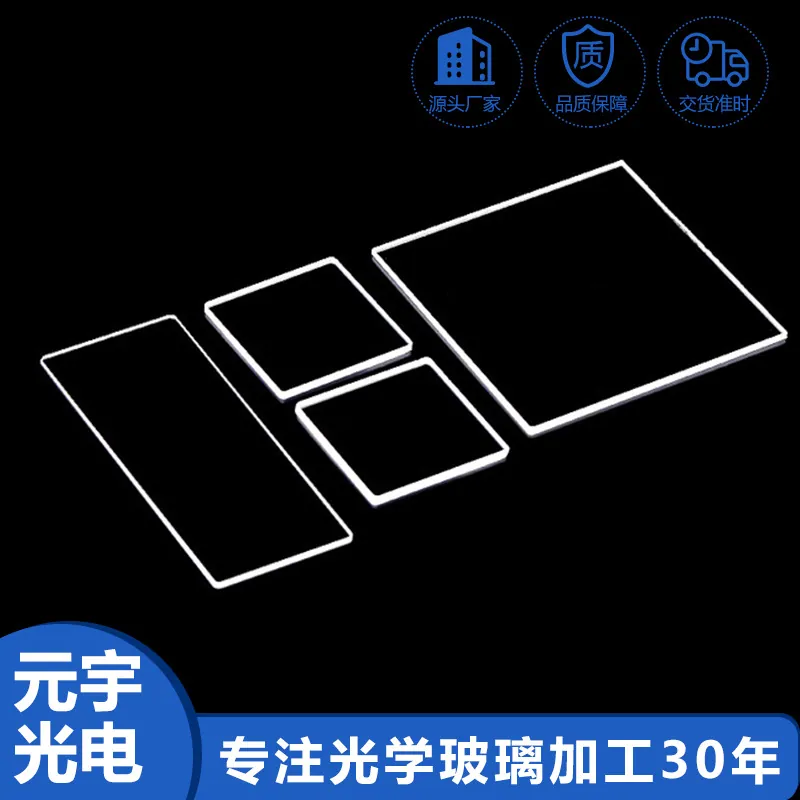
Lens Protection Windows in CubeSat and Small-Satellite Optical Payloads
The front window is the first optical surface a payload sees: it seals the optical head against contamination during integration and launch, and it shields the internal lenses from the space environment in orbit. For a star tracker it also defines the baffle entrance; for an imager it sits in the full aperture and therefore sets the first reflection and the first thermal load. Because small satellites are mass- and power-limited, the window cannot be a heavy, over-specified part, yet it must not be the component that fails on vibration or outgasses onto a neighbouring surface. The design is a balance of substrate mass, coating performance and a tolerance set the launch and orbit can actually survive.
What drives cost and lead time
Cost is driven by substrate grade and by qualification. Fused silica and BK7 are inexpensive and fast for standard sizes; sapphire and radiation-hard glasses cost more and take longer to source and to prove flightworthy. Lead time grows when the window must be anti-reflection coated on both faces to a narrow band, or when it is bonded into a flange or baffle as part of a qualified assembly. Custom shapes and diameters add weeks. For most small-satellite payloads the economical route is a standard substrate with a simple dual-band AR coat, reserving sapphire or radiation-hard glass for the cases where micrometeoroid, abrasion or dose genuinely require them.
Substrate and material selection
Fused silica is the common choice: low mass for its strength, good transmission across visible and near-infrared, and low thermal expansion that holds figure through orbit temperature swings. BK7 is cheaper and fine for visible payloads that do not need silica's expansion or transmission range. Sapphire is chosen when the window may be abraded or when its hardness against micrometeoroid erosion is worth the mass and the birefringence caveat. Radiation-hard glass is selected when the orbit dose would darken ordinary glass over the mission. The selection balances mass, transmission band, radiation and abrasion, with mass usually the first constraint on a small satellite.
How it compares with the alternatives
Against leaving the aperture open with only an internal lens, a front window wins on contamination and handling protection but costs mass and adds two surfaces of reflection to control. Against a polymer or bonded film, glass wins on outgassing, scratch resistance and thermal stability and loses on impact toughness. Against sapphire, silica is lighter and cheaper with better broad transmission, while sapphire wins only where hardness or a specific band is required - and sapphire's crystal birefringence must be oriented or accepted. For a small-satellite payload the comparison is usually silica versus sapphire on mass and environment, with the window qualified as part of the optical head.
Coating and deposition considerations
The window almost always carries an anti-reflective coating on both faces, centred on the payload's operating bands - commonly visible plus near-infrared for Earth observation, or a narrower band for a star tracker. The coating must survive launch vibration and the thermal and radiation environment without delaminating or darkening, so it is qualified with the substrate, not selected afterwards. Where the window is also an electromagnetic boundary, a conductive coating such as indium tin oxide may be applied, but it must be kept off the optical aperture or balanced against transmission loss. State which faces are coated and to what band, and confirm the coating is rated for the orbit's dose and temperature, because an unqualified coating is the usual weak link.
Requirements specific to CubeSat and Small-Satellite Optical Payloads
The distinctive drivers are mass and a sealed, qualified optical head, so the window is chosen light and then proven as part of the assembly rather than optimised alone. The other point is the environment: launch vibration, orbit temperature swing, radiation dose and contamination control all bear on the substrate and coating, and the acceptance is against the mission profile, not a generic space claim. Specify the operating bands, the orbit dose and the mass cap, and confirm the coating is qualified for that environment.
- Fused silica default; sapphire only where abrasion or hardness justifies the mass
- Dual-face AR tuned to the payload bands; qualified with the substrate
- Mass is the first constraint - avoid over-specifying the window
- Window qualified as part of the optical head under the mission profile
Framework references: optical element tolerances follow ISO 10110; launch, thermal, radiation and contamination acceptance follow the mission's own specification. Operating bands and orbit dose are set by the payload design; confirm against the current mission specification rather than a generic space-grade claim.
Selection data at a glance
| Parameter | Typical value | Notes |
|---|---|---|
| Substrate | fused silica default; sapphire if needed | Mass is first constraint |
| Transmission | visible + NIR typical | Per payload band |
| AR coating | both faces, tuned to bands | Qualified with substrate |
| Radiation | hard glass if dose requires | Per orbit profile |
| Conductive coat | ITO only if EMI boundary | Keep off aperture |
| Qualification | as part of optical head | Mission profile |
Frequently asked questions
Is sapphire worth the mass on a small satellite?
Usually not, unless the window may be abraded or needs a band silica does not pass. Fused silica is lighter, cheaper and transmits broadly; sapphire wins only on hardness, at the cost of mass and crystal birefringence that must be managed.
Why coat both faces of the window?
Because the window sits in the full aperture, so both surfaces return stray reflections into the payload. A dual-face anti-reflective coat centred on the operating bands suppresses that, and it must be qualified for launch and orbit alongside the substrate.
How is the window accepted for flight?
As part of the qualified optical head, against the mission's vibration, thermal, radiation and contamination requirements - not as a standalone optic. Specify the operating bands, orbit dose and mass cap so the coating and substrate are proven for that profile.
Need a quotation for lens protection windows?
Send your drawing, target specification or coating requirement and an optical engineer will reply within 24 hours with a price and a lead time.
Request a Quote Email an engineer