Portable field spectrometer probes are pushed into soil, water and process streams and rely on a window to keep the optics clean while passing the measurement band, and the lens-protection window is the disposable barrier that takes the abrasion, the chemistry and the immersion so the actual lens does not. The window has to resist scratches and chemicals while costing little enough to be treated as a consumable, but it is only one of several ways to protect the optic. This article lays out the material, coating and tolerance trade-offs for lens protection used on portable field spectrometer probes.
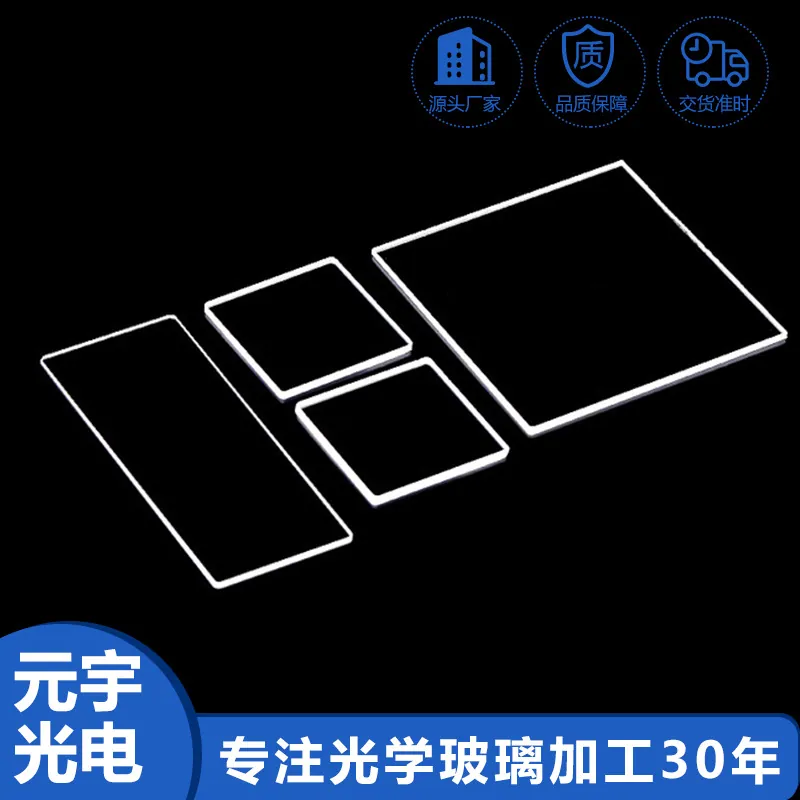
Lens Protection Windows in Portable Field Spectrometer Probes
Portable field spectrometer probes are pushed into soil, water and process streams and rely on a window to keep the optics clean while passing the measurement band, and the lens-protection window is the disposable barrier that takes the abrasion, the chemistry and the immersion so the actual lens does not. The window has to resist scratches and chemicals while costing little enough to be treated as a consumable, but it is only one of several ways to protect the optic. This article lays out the material, coating and tolerance trade-offs for lens protection used on portable field spectrometer probes.
What drives cost and lead time
Cost is driven by material, aperture and the coating, and lead time by whether the part is a standard size or a custom moulded window. Sapphire windows cost more and take longer than hardened glass or polymer, and a custom shape adds tooling. Specify the minimum aperture and the loosest tolerance the probe can accept, because a consumable window should be cheap enough to replace, not specified to catalogue best.
Substrate and material selection
Select a window material whose hardness and chemical resistance match the sample the probe meets, and confirm it transmits the band the instrument uses. Sapphire is the hardest and most chemically resistant but costs more, a hardened optical glass is a cheaper middle ground, and a polymer film is lightest and cheapest but scratches and swells fastest. Match the material to the environment first - soil and reagent favour the hardest, most inert option - then to the budget.
How it compares with the alternatives
A sapphire window is the most scratch and chemical resistant and is the choice where the probe is routinely abraded or immersed, but it costs the most. A hardened glass window is cheaper and good enough for general field use, and a polymer film is lightest and cheapest but must be replaced often. Compared with no window at all, any of these trades a little transmission for an optic that survives the field.
Coating and deposition considerations
An AR coating on the probe window recovers the Fresnel loss at the measurement wavelengths and raises the collected signal, but it must survive immersion, abrasion and repeated cleaning. The coating is designed for the actual angle of incidence and the band, and a hard, dense stack is preferred for field duty. State the design wavelength, the angle and any chemical-exposure limit, because a coating tuned for a dry bench will not survive a reagent dip.
Requirements specific to Lens Protection for Portable Field Spectrometer Probes
Field duty exposes the window to soil, reagents, immersion and handling, so hardness and chemical resistance lead the specification, with cost kept low enough that the part is a consumable. Pick sapphire where abrasion and chemistry are constant, hardened glass for general field use, or polymer film where weight and price dominate, and keep flatness and wedge to what the probe optics tolerate. Qualify the part against the actual sample and cleaning cycle - not a generic scratch grade - because a field probe is judged by the readings it still delivers after the trip.
- Sapphire vs hardened glass vs polymer film
- Hardness and chemical resistance matched to sample
- Flatness and wedge kept to the probe optics
- Cost low enough that the window is a consumable
- Surface quality controlled to avoid signal scatter
- AR coating rated for immersion and cleaning
Framework references: surface form, parallelism, scratch-dig and coating uniformity per ISO 10110, and environmental durability per the relevant instrument or equipment rule set. Environmental declarations such as RoHS are the supplier's to state against the current official text, not to be assumed for a component used in optical instruments.
Selection data at a glance
| Parameter | Typical value | Notes |
|---|---|---|
| Option | Hardness | Cost |
| Sapphire | Highest | Highest |
| Hardened glass | Mid | Mid |
| Polymer film | Lowest | Lowest |
| None | None | n/a |
| Use case | Abrasion + reagent | Consumable |
Frequently asked questions
Is sapphire worth the cost for a field spectrometer probe?
If the probe is routinely abraded by soil or immersed in reagents, yes - sapphire is the hardest and most chemically resistant and will outlast the rest. For gentle field use a hardened glass window is usually enough, and a polymer film only makes sense where weight and price dominate and frequent replacement is acceptable.
Will a protection window hurt measurement quality?
Only if its flatness or wedge is loose, because the probe optics amplify those errors. Keep flatness and wedge to what the optics tolerate and control surface quality so it does not scatter light, and the window adds negligible error while saving the lens.
Why treat the window as a consumable?
Because a field probe's value is in the readings it still delivers after abuse, and a scratched, etched or cracked window is cheaper to replace than a lens or a calibrated optic. Specifying it cheap and tough, rather than to catalogue best, keeps the instrument serviceable in the field.
Need a quotation for lens protection windows?
Send your drawing, target specification or coating requirement and an optical engineer will reply within 24 hours with a price and a lead time.
Request a Quote Email an engineer