Particle image velocimetry cameras in wind tunnels and fluid labs fire a double-pulse laser through a window at a seeded flow and image the scattered light to measure velocity. The window in that path must pass the laser wavelength with minimal loss, hold the image geometry, and not add stray light or disturb the flow, while surviving the seeding-particle contamination and cleaning that come with the job. This article compares the practical choices for a PIV window and where each trade-off pays off.
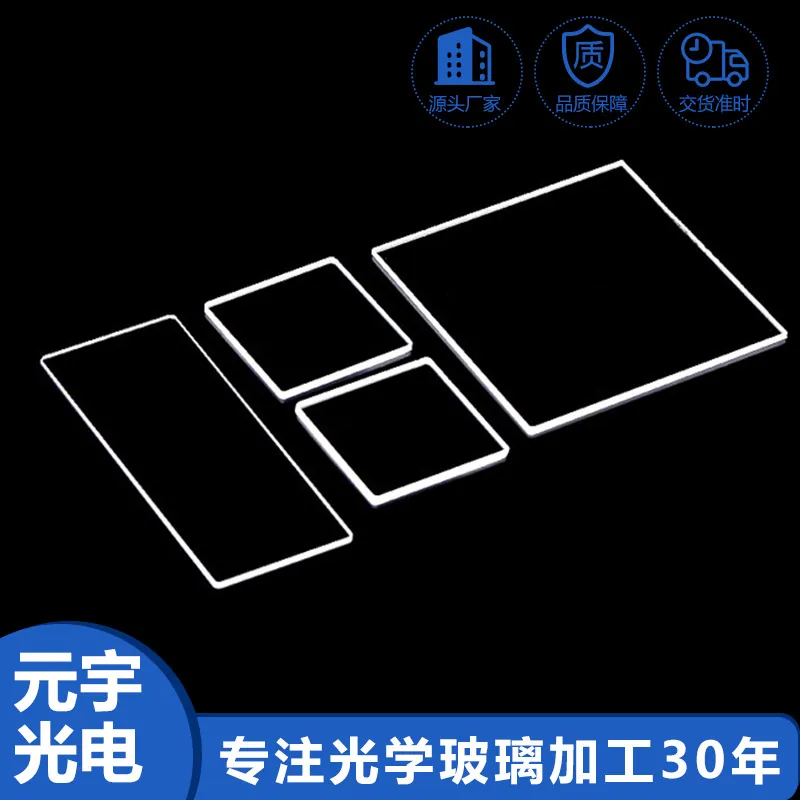
Lens Protection Windows in Particle Image Velocimetry
In a PIV setup the camera looks through a window at a measurement volume lit by a double-pulse laser, typically in the green or near-UV depending on the system. The window is the optical cavity wall: it has to pass the laser line with high transmission, keep the image free of ghost and geometry error, and stay sealed so the flow sees a clean surface. The duty is a laboratory or test-rig environment rather than a field, but the window is wiped often because seeding particles and tracer fluid land on it, and it may be flush-mounted in a wall where any protrusion disturbs the boundary layer. Those two facts, cleaning and flow neutrality, decide more than the base material.
What drives cost and lead time
Cost follows a simple flat round or rectangular window in a standard thickness, with a coating tuned to the laser line and a first-article transmission report. Volume across a lab or a fleet of rigs amortises the coating run, so the design favours a standard size that can be re-ordered rather than a one-off shape. Curved or shaped windows, tight wedge requirements and unusual sizes all add cost and lead, and the first-article transmission and wavefront check is a one-off the programme should absorb once. The coating, not the substrate, is usually the schedule driver.
Substrate and material selection
Substrate choice follows the laser and the environment. B270 or ultra-clear float glass is adequate for visible PIV and is the cheapest optic that transmits well; borosilicate adds thermal and chemical stability for a rig that runs hot or sees solvents; fused silica is chosen when the laser is UV or when the lowest scatter and best homogeneity matter. Sapphire is reserved for a genuine wear surface where the window is bumped, because its hardness keeps the surface intact through impacts that would pit glass, at a cost justified by removing a replacement cycle rather than by optical gain. Thickness is set by pressure and mounting, not by transmission.
How it compares with the alternatives
Leaving the sensor exposed avoids the window but disturbs the flow and loses the sealed cavity, so it suits only a clean, low-speed rig. A moulded polymer window is cheap and impact-tolerant but scratches and is limited in the UV bands that matter, so it fits a visible-only camera and poorly suits a laser line. An anti-glare etch scatters reflected light and helps a visible camera see through the window while doing nothing for transmission at the laser wavelength. Coated glass remains the default because it solves transmission, sealing and cleaning at once, and the trade is between substrate grade and coating durability rather than between coated and uncoated.
Coating and deposition considerations
The standard coating for a PIV window is a narrowband anti-reflection stack tuned to the laser line, often with a hydrophobic and oleophobic topcoat so seeding fluid and fingerprints wipe off. That topcoat is the layer that decides cleaning life: a hard oxide stack transmits well but holds contamination, and a soft fluoropolymer sheds it but wears through, so the practical answer is a hard oxide stack with a thin fluorosilane finish specified by abrasion cycles rather than by an initial contact angle. Where the window is in the imaging path at non-normal incidence, the coating is validated on the assembled module, because the window is rarely square to the beam.
Requirements specific to Particle Image Velocimetry
A PIV window must pass the double-pulse laser band with minimal loss and no ghost, hold the image geometry through wedge and flatness, and withstand seeding-particle contamination and the cleaning that follows. It is mounted flush and sealed so the boundary layer stays clean, and the mount geometry is part of the spec rather than just the glass. The coating is specified by abrasion cycles because the window is wiped often, and the substrate is chosen by the laser line and the rig environment. Stray light from a poor coating reads directly as noise in the velocity field, so the AR is qualified at the laser wavelength, not at the visible average.
- Narrowband AR at the PIV laser wavelength
- Wedge and flatness holding image geometry
- Hard coating resisting cleaning abrasion
- Flush, flow-neutral mount
Framework references: laser-wavelength anti-reflection per the PIV system's laser line, surface form and wedge per ISO 10110-5, and scratch-dig per ISO 10110-7. The laser band follows the component specification; confirm against the current supplier datasheet rather than assuming a single value.
Selection data at a glance
| Parameter | Typical value | Notes |
|---|---|---|
| Transmission | over 98 % at laser wavelength | Narrowband AR |
| Reflectance | below 0.5 % at band | Ghost control |
| Substrate | B270, fused silica, borosilicate | Per laser and rig |
| Thickness | 1-3 mm typical | Pressure driven |
| Wedge | per imaging need | Image geometry |
| Hardness | hard oxide, abrasion-resistant | Cleaning life |
| Mount | flush, sealed | Flow neutral |
Frequently asked questions
Why a narrowband AR at the laser wavelength?
A PIV system images on a double-pulse laser line, and an AR stack tuned there lifts transmission and kills the ghost that would blur the particle image, where a visible-average coating would lose at the laser line. The coating is qualified at the laser wavelength, not at the visible average.
Does the window disturb the flow?
It can if it protrudes. PIV windows are mounted flush and sealed so the boundary layer stays clean, and the mount geometry is part of the specification, not just the glass, because a bump in the wall changes the very velocity field being measured.
Fused silica or B270 for PIV?
B270 is fine for visible PIV and cheaper; fused silica is chosen when the laser is UV or when the lowest scatter and best homogeneity matter, at higher cost. Match the substrate to the laser line and the rig environment rather than defaulting to the premium grade.
Need a quotation for lens protection windows?
Send your drawing, target specification or coating requirement and an optical engineer will reply within 24 hours with a price and a lead time.
Request a Quote Email an engineer