Textile and nonwoven webs run continuously at speed past inspection cameras, and the protective window in front of the lens is the part that decides when the line stops. Lint, fly, sizing and dye mist land on that window, neighbouring machine parts scour it, and the compressed air used to blow the web keeps hitting the same spot every revolution. Choosing the window is therefore a set of trade-offs between substrate hardness, coating durability, flatness and how often the machine can be stopped to clean it.
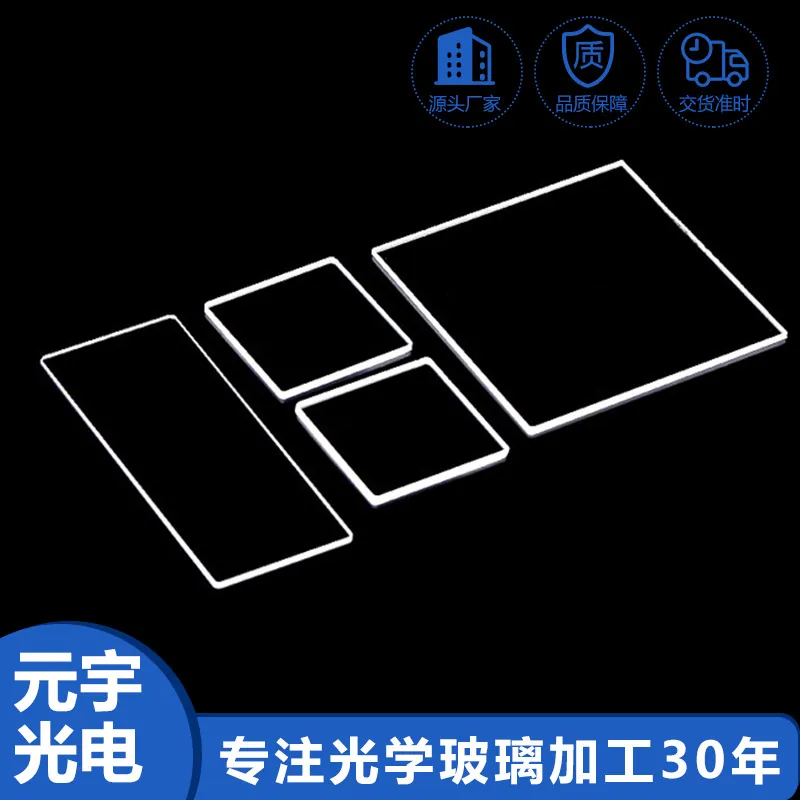
Lens Protection Windows in Textile and Nonwoven Inspection
On a spinning frame or a nonwoven line the camera looks at the web under bright process lighting, and the first optical surface the light meets is the protective window rather than the objective itself. Its job is to absorb contaminating and abrasive contact so the expensive lens does not have to, while adding as little reflection, haze and wavefront error as possible. Because the window sits ahead of a fixed-focus system, any bow or tint in it turns into a contrast loss on the web rather than an easily corrected focus shift. The practical consequence is that the window must be specified as an optical part, not as a cover slip, and the maintenance plan should treat it as a scheduled consumable with a known replacement interval.
What drives cost and lead time
Cost is driven less by the raw material than by the edges, the flatness and the coating hardness. A window polished on both faces to a close thickness tolerance costs more than a single-face polished part, because parallelism has to be held if the window is not to introduce wedge. Lead time depends on whether the outline is a standard rectangle or circle already in the tooling, or a slot cut to match a particular camera housing. A bevel or a ground edge that lets the part seal into a housing adds a second operation, so the cheapest sensible window is usually the one that fits the existing housing geometry without modification. Where a line runs continuously, the cost of an unplanned cleaning stop typically dwarfs the price gap between two window options, which argues for paying more for a harder and easier-to-clean surface.
Substrate and material selection
The substrate is chosen against the two things that actually damage the window: scouring by dry fibre and thermal cycling near dryers or calenders. A hard inorganic glass resists abrasion far better than most polymers and tolerates the solvents used on textile lines, while a polymer window is lighter and cheaper but scratches readily and can hold a static charge that pulls lint towards the optical path. Where the camera sits close to a heated calender the substrate also has to keep its dimensions and its surface through the heat, which rules out the least expensive plastics. The material must additionally be compatible with the cleaning regime already approved on the line, since a window that can only be cleaned with one solvent tends to end up being cleaned with whatever is on the bench.
How it compares with the alternatives
Against running unprotected, a protection window trades a small amount of extra reflection for a large reduction in lens cleaning and in the risk of a scratch that forces a housing strip-down. Against a mechanical shutter or an air knife alone, the window still gets dirty but is far cheaper to replace than a lens assembly and can often be swapped without stopping production. A coated polymer is cheaper than coated glass and survives impact better, yet it fogs and scratches, which shifts the camera contrast slowly and produces false rejections that are easy to misdiagnose as a process problem. Glass with a hard multi-layer coating outlasts bare glass in a dusty area by a wide margin, and the coating must in every case be agreed against the cleaning solvent actually used in the plant rather than a generic industrial durability claim.
Coating and deposition considerations
A protection window coating has to do two jobs at once: keep reflection low in the visible band the camera works in, and stay hard enough to survive repeated wiping. A broadband anti-reflection layer performs the first job well but is generally softer than a single hard oxide top layer, so on a window that will be wiped often the arc is deliberately traded for a more durable single layer that only reduces the worst of the reflection. Deposition quality matters directly because a coating that pinholes or mottles shows up as a fixed pattern on the web and gets read as a fabric defect. If the surroundings carry an anti-static treatment or the plant uses an ionising blower, the stack should be specified together with that condition, since a coating chosen only for appearance can fail as a static collector in a fibre-rich environment.
Requirements specific to Textile and Nonwoven Inspection
A textile or nonwoven line adds fibre contamination and dry abrasion to the usual window requirements. State the window outline against the existing housing rather than the other way round, choose a substrate that survives the approved cleaning solvent and the heat near any calender, and accept the reflection penalty of a durable single-layer coat where wet wiping is frequent. A flatness and parallelism figure worth holding is stated under the general optical drawing rules, and the practical step is to confirm the values in the current issue of the standard that governs optical tolerances rather than in a supplier catalogue.
- Window outline matched to the existing housing before any tooling is cut
- Substrate chosen against the approved cleaning solvent and local heat
- Durable single-layer coat preferred over soft broadband arc where wiping is frequent
- Scheduled replacement interval agreed with the maintenance department
- Coating specified with the anti-static condition of the machine in mind
Framework references: optics tolerances and surface quality are generally stated in ISO 10110; cleaning and durability expectations should be confirmed against the current issue of that standard and the plant's own chemical approval list rather than taken from a supplier datasheet.
Selection data at a glance
| Parameter | Typical value | Notes |
|---|---|---|
| Substrate type | Hard glass or polymer | Abrasion vs cost |
| Both faces polished | Parallel, low wedge | More cost, stable focus |
| Coating | Hard single layer or arc | Cleaning life vs reflection |
| Outline | Standard rect / circle first | Keeps lead time short |
| Edge finish | As-cut or beveled | Fits housing sealing |
| Replacement interval | Scheduled, not reactive | Limits unplanned stops |
Frequently asked questions
Should the window be polished on both faces?
Yes where the camera is fixed focus. A single-face polished part can introduce wedge that shifts contrast across the field in a way that looks like a process problem. The extra parallelism cost is usually small next to the cost of a misdiagnosed inspection fault.
Is a polymer window good enough for a dusty spinning floor?
Cheaper and impact resistant, but polymers scratch easily and hold static that pulls lint toward the optical path. In a high-fibre environment the inferior cleaning life usually costs more in stoppages than the saved part price is worth.
How often should the protection window be replaced on a running line?
As a scheduled item with an interval agreed with maintenance, rather than reacting to a fall in detection rate. A window swapped at a planned stop is a consumable cost; the same window discovered mid-shift is usually a missed defect batch as well.
Need a quotation for lens protection windows?
Send your drawing, target specification or coating requirement and an optical engineer will reply within 24 hours with a price and a lead time.
Request a Quote Email an engineer