A metal laser powder-bed fusion machine floods its beam path with powder, spatter and recoil pressure, and the optics that shape and direct the laser sit behind protective windows and scan mirrors that take the abuse. Cold-processed glass parts are the planned sacrifice in that path, and the build choice is between a disposable window, a coated quick-swap cassette and a sapphire plate. This comparison sets out where each belongs.
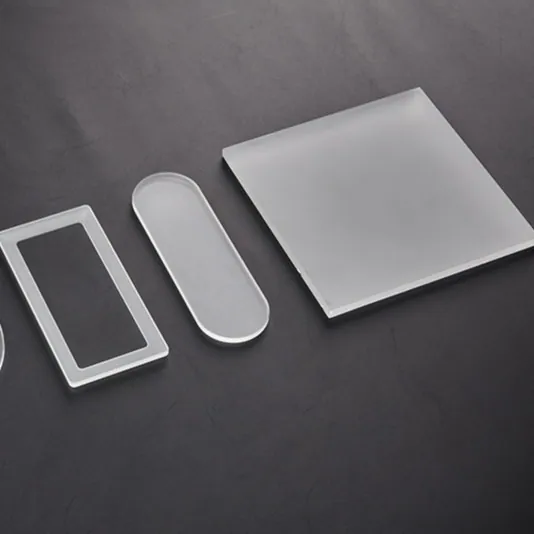
Optical Glass Cold Processing in Additive Manufacturing Optics
In a powder-bed fusion machine the laser passes through an f-theta lens and a scan mirror before reaching the bed, and a protective window seals the optics chamber from the build volume. That window sees spatter, condensate and the recoil pressure of each melt, and it is the part that clouds first. The mirror and lens are expensive and fixed; the window is cheap and consumable. The optical requirement is good transmission at the laser wavelength and a clean, flat surface, while the production requirement is a part that swaps fast and traces to its lot.
Substrate and material selection
For most machines a borosilicate or quartz window coated for the laser wavelength is enough and cheap to replace; sapphire earns its cost only where spatter impact is constant and a glass window pits too fast. A coated cassette adds a quick-swap frame and a repeatable seal so the swap is minutes, not a rebuild, at the price of a fixture. The substrate choice follows the duty at the window: gentle, intermittent spatter stays on glass; a high-energy, high-duty station moves to sapphire or a thicker coated plate.
What drives cost and lead time
Cost is dominated by how often the window is swapped and whether a cassette standardises the swap, not by the glass itself. A bare disposable window is cheap per unit but costs downtime on every change; a cassette costs more up front and saves it back in swap speed and seal repeatability. Lead time is set by the coating run and any cassette fixture, not by grinding a flat. The practical lever is buying disposable windows in lot quantity and holding cassettes as the controlled spare, so a clouded window is a stock swap.
The tolerances that actually matter
For a protective window the tolerances that matter are surface form enough that the beam is not distorted, wedge small enough that aim is not shifted, and a coating centred on the laser wavelength with uniform transmission across the aperture. A window in the beam path that is wedged or wavy steering the spot is a build defect, not a cosmetic one. Edge and seal quality matter because the window is a pressure boundary; a chipped edge or a poor seal lets powder into the optics chamber, which is the expensive failure the window exists to prevent.
How it compares with the alternatives
Against no window at all, any protective window wins by saving the mirror and lens, which is why a window is standard. Against a bare glass window, a coated cassette swaps faster and seals repeatably, paying back in uptime. Against sapphire, glass is far cheaper and good enough at most stations, while sapphire lasts where spatter is relentless. The comparison is therefore per station: disposable glass for the average duty, cassette for fast swap, sapphire for the harsh one, with the scan mirror and f-theta lens protected behind all of them.
Requirements specific to Additive Manufacturing Optics
Additive manufacturing adds a powder, spatter and recoil-pressure axis that metrology or display optics never see. The window must hold transmission at the laser wavelength, stay flat enough not to steer the spot, and seal the optics chamber from the bed, and it must swap fast on a maintenance interval. Specify the substrate by station duty, a cassette where swap speed pays back, and a lot record tied to the coating, and treat the seal as a pressure boundary rather than a cosmetic edge.
- Substrate by station duty: glass for average, sapphire for harsh
- Cassette where fast, repeatable swap pays back
- Wedge and surface form tight enough not to steer the beam
- Seal treated as a pressure boundary, lot traced to coating
Framework references: surface-figure and scratch-dig limits per ISO 10110; the laser wavelength and process window follow the machine maker's optical specification. Swap intervals and spatter duty are process-specific and should be confirmed against the station's maintenance records rather than a generic window claim.
Selection data at a glance
| Parameter | Typical capability | Notes |
|---|---|---|
| Substrate | borosilicate, quartz, sapphire | By spatter duty |
| Coating | laser-wavelength AR | Uniform across part |
| Surface form | beam-stable flatness | Per ISO 10110-5 |
| Wedge | aim-stable limit | No spot steer |
| Seal | pressure boundary | Blocks powder |
| Swap | cassette or disposable | Buffer stock |
Frequently asked questions
Can a machine run without a protective window?
It should not. The window exists to save the scan mirror and f-theta lens behind it; without it, powder and spatter reach the expensive optics and the failure is a rebuild, not a swap. A protective window is the planned sacrifice in the beam path.
Is sapphire worth it for every additive station?
Rarely. Glass coated for the laser wavelength is far cheaper and good enough at most stations; sapphire earns its cost only where spatter impact is constant and a glass window pits too fast. Reserve it for the harsh-duty station and standardise glass elsewhere.
Why treat the window seal as a pressure boundary?
Because the window separates the clean optics chamber from the build volume under recoil pressure. A chipped edge or poor seal lets powder into the optics, which is the expensive failure the window is there to prevent, so the seal is specified and inspected as a boundary, not a cosmetic edge.
Need a quotation for optical glass cold processing?
Send your drawing, target specification or coating requirement and an optical engineer will reply within 24 hours with a price and a lead time.
Request a Quote Email an engineer