A fluorescence filter cube contains three optical components: an excitation filter, a dichroic mirror and an emission filter. Each is a coated filter with its own curve, and each is routinely purchased, specified and priced separately. That is also the most common reason fluorescence systems underperform.
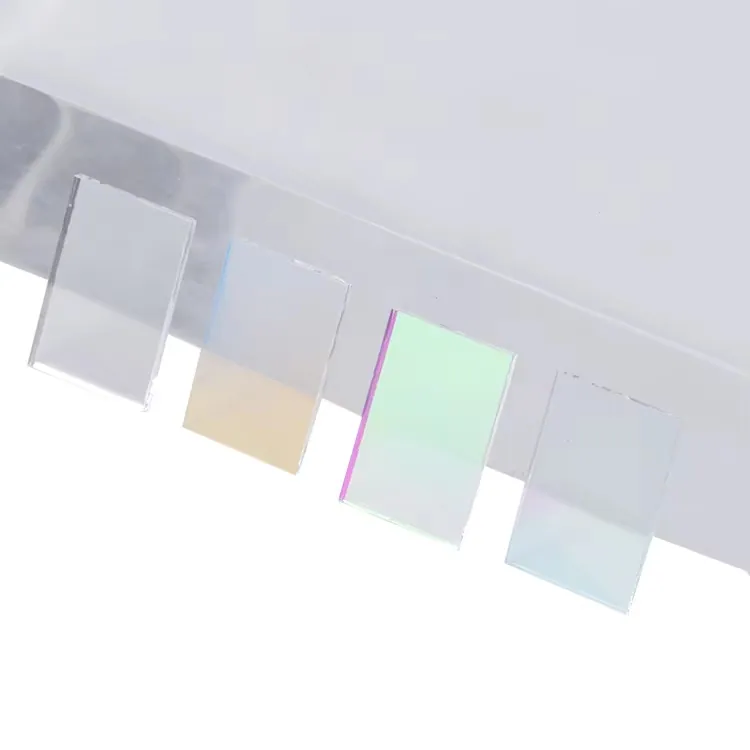
The components interact. Their curves overlap in ways that are not visible when each is examined alone, and the failure they produce — bleed-through, weak signal, or a background that no amount of gain can fix — looks like an instrument problem rather than a procurement one.
The three-way interaction
The excitation filter defines the band that reaches the sample. The dichroic decides which of the returning light is reflected toward the detector and which is transmitted away. The emission filter cleans up what the dichroic passes.
Each transition region is where trouble lives:
- Excitation passband versus dichroic edge. If the excitation band extends past the dichroic's transition, excitation light leaks into the emission path. The dichroic reflects it toward the sample but also, at those wavelengths, transmits some of it toward the detector.
- Dichroic edge versus emission passband. If the emission band starts too close to the dichroic transition, the dichroic's own imperfect transition — its finite slope and its polarisation splitting at 45 degrees — modulates the emission signal across the field.
- Excitation and emission overlap. In widely used filter sets the two bands are separated by a gap chosen so that no excitation light reaches the detector. Narrow that gap for brightness and you buy signal at the cost of bleed-through.
A set is designed so that these three interactions are resolved together. Three independently purchased filters are each optimised for their own curve, which is not the same thing.
Why separate purchasing persists
The reasons are organisational rather than technical. Purchasing departments buy filters by part number; part numbers are per component; budgets are per line item. A cube assembly is three lines and a mount, and splitting them across suppliers can look like better price discovery.
It usually is not. The cost of a bleed-through problem is a redesign cycle, and the cost of a weak signal is either a more expensive detector or a lost sale. Neither appears on the filter purchase order.
What a matched set delivers
A properly designed cube set offers four things that separate components rarely do:
- A defined spectral gap between excitation and emission, sized to the fluorophore's Stokes shift rather than to a catalogue convenience.
- A dichroic edge placed with margin, so that manufacturing tolerance in both the dichroic and the emission filter does not close the gap on the worst-case part.
- Consistent polarisation behaviour, since the dichroic at 45 degrees splits polarisations and the emission filter's performance in the transmitted beam depends on what the dichroic did to it.
- One set of metrology data, measured on the assembled combination, which is the only measurement that predicts system performance.
The specification conversation
Buyers moving from component purchasing to set purchasing need three pieces of information that component datasheets do not contain:
1. The fluorophore or dye panel, with excitation and emission peaks and the Stokes shift. 2. The illumination geometry — epi-illumination with a dichroic at 45 degrees behaves differently from a transmitted-light arrangement. 3. The detector's spectral response, because a set optimised for a CCD is not automatically optimal for a CMOS sensor with different NIR sensitivity.
With those three, a supplier can propose a set with a stated spectral gap, a stated blocking level across the full detection range, and a predicted signal-to-background ratio. Without them, the supplier is guessing at the application and quoting curves.
Mounting and assembly
The cube itself is a mechanical component and a frequent source of problems. Cube bodies vary in internal geometry, the dichroic sits at 45 degrees with some angular tolerance, and the excitation and emission filters are held in bores with their own tilt.
Suppliers who deliver pre-mounted, pre-aligned cubes remove an assembly step and a source of variance from the customer's line. The trade-off is that the cube becomes a single part number with a single price, which some procurement processes resist — but the alignment is done once, in a fixture, by the party with the metrology to verify it.
When separate purchasing is right
There are legitimate cases: replacing a single damaged component in an existing instrument, or building a custom path where the geometry is unusual enough that no standard set applies. In those cases, the minimum discipline is to specify the three components against each other — the emission filter's blocking range must cover the excitation band, and the dichroic's transition must sit between them with stated margin.
That is a smaller version of what a set supplier does, and it costs nothing but attention at the specification stage.
The market direction
Multiplexed imaging, spectral unmixing and high-content screening all increase the number of cubes per instrument, which multiplies the interaction risk. At the same time, instrument makers are consolidating suppliers to reduce qualification overhead. Both trends point the same way: the unit of purchase is becoming the set, not the filter.