The business case for single-use endoscopes is usually told in infection-control language: no reprocessing, no cross-contamination risk, no damaged channels from repeated sterilisation. All true. But the shift has a second consequence that receives far less attention — it changes the optical bill of materials completely, and it changes the kind of supplier that can serve it.
A reusable scope is built to survive hundreds of cycles. A single-use scope is built to survive one procedure, at a price that makes discarding it acceptable. Those are opposite design briefs, and the optics inside them look different in ways that reach all the way down to substrate grade, coating choice and inspection criteria.
From durability to disposability
Reusable endoscopes pushed optics toward maximum robustness: sapphire windows where abrasion was severe, thick sealed assemblies, and coatings qualified against repeated autoclave cycles. Single-use devices invert the priority. The part must survive ethylene oxide or gamma sterilisation once, remain optically clean for the procedure, and cost little enough that the whole device can be thrown away.
That inversion produces a different set of trade-offs:
- Thinner windows, lower material grades where the optical path allows. Not every surface in a disposable device needs to be fused silica; where the imaging requirement is modest, cheaper optical glass with a good AR coating does the job.
- Fewer, simpler coatings. A single-layer or two-layer AR design that meets the transmission target beats a twelve-layer broadband stack that adds cost and process risk.
- Assembly-friendly geometry. Disposable devices are assembled at speed. Parts that self-align, stack in a fixed orientation or come pre-mounted on a carrier reduce labour, which is often a larger cost than the optic itself.
- Inspection criteria tuned to the application. A disposable device with a 400 × 400 pixel sensor does not need the same surface quality as a 4K surgical visualization system. Over-specifying is a direct margin loss.
Why the filter set still matters
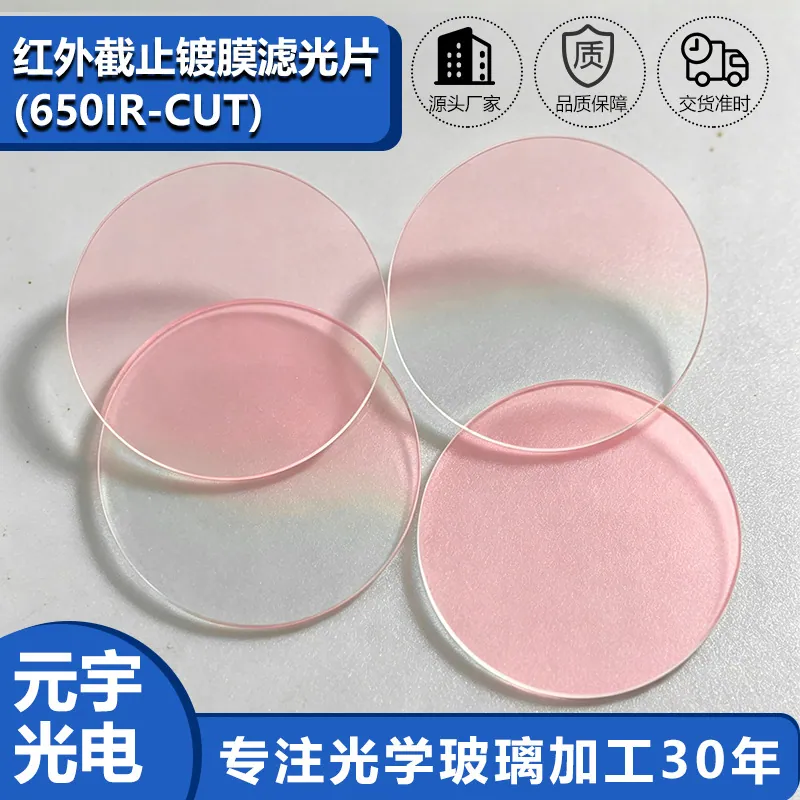
Cost pressure does not remove the optical function. Most single-use imaging chains still need an IR-cut or short-pass filter in front of the sensor, because CMOS sensors remain sensitive well beyond the visible band and near-IR leakage washes out colour fidelity under the strong illumination these devices use.
That filter is now a disposable component, which creates a specific requirement: it must be stable enough to hold its spectral edge through sterilisation, and cheap enough to be discarded. Gamma sterilisation is the harder case — it can discolour some glasses and degrade certain coating materials — so the filter substrate and the coating have to be selected as a pair, not independently.
The same logic applies to illumination path optics. Light delivery through a fibre bundle or an LED at the distal tip passes through windows and lenses that must survive the same sterilisation and the same cost target.
The supply-chain consequence
Single-use devices favour suppliers who can deliver at volume with consistent, documented quality — and who can support the design phase rather than only the production phase. Three capabilities matter more than they did in the reusable era:
- Wafer-level or panel-level processing, so hundreds of small filters are coated and diced in one run rather than handled individually.
- Mounted and pre-assembled options, because the customer's assembly line, not the optics bench, is where cost is won or lost.
- A pragmatic approach to specification, helping the OEM match optical performance to the actual imaging requirement instead of quoting a generic precision standard.
A note on the regulatory dimension
Single-use devices are usually regulated medical products, which brings documentation requirements that optics suppliers outside the medical market often underestimate: material traceability, biocompatibility of anything patient-contacting, change control, and validation support. A supplier who has never shipped into a regulated device programme will need time to build those processes, and programmes that assume otherwise lose months.
The direction of travel is clear. Single-use is expanding from urology and bronchoscopy into more of the endoscopy portfolio, and each new indication brings another imaging chain with its own cost target. The optics inside those devices will be simpler than their reusable predecessors — but they will be specified more carefully than most people expect, because in a disposable device, every unnecessary micron of performance is money burned.