For a decade the default answer to any spectral filtering question was a thin-film coating. Interference filters offer steep edges, high peak transmission, deep blocking and precise centring — and the coating industry got very good at making them cheap.
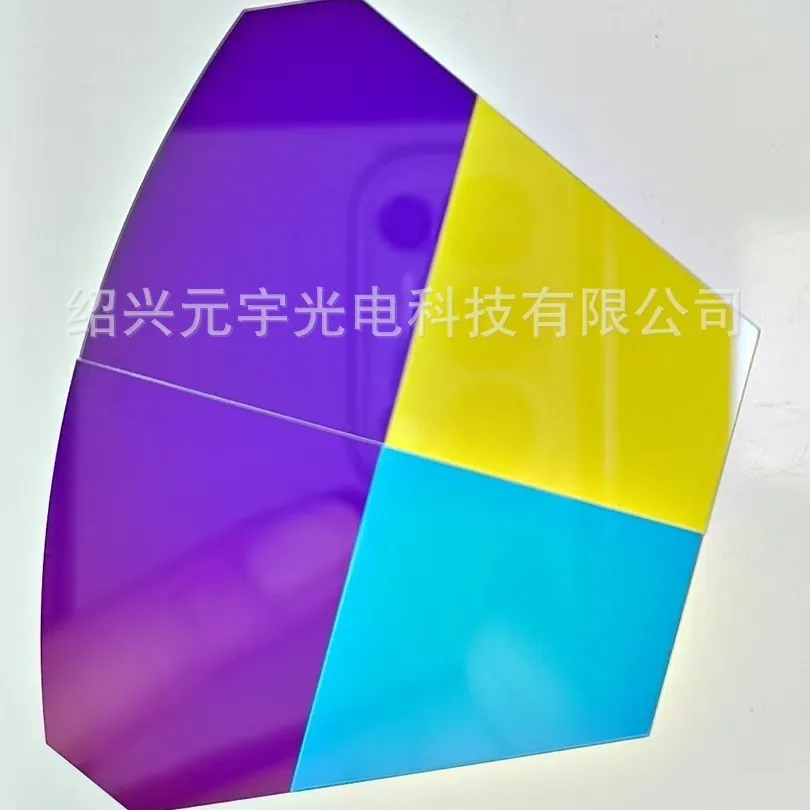
And yet filter glass keeps reappearing in new designs, not as a legacy part but as one half of a hybrid.
What absorption glass does that coatings cannot
Colored glass — the BG, GG, RG and UG families, and their equivalents from the major glassmakers — selects wavelengths by absorbing them in the bulk material rather than by interference. That mechanism has two consequences that matter in real instruments: the spectral behaviour is largely independent of angle, and the blocking extends continuously from the edge to the deep UV or far IR without needing extra layers.
Angle independence is the big one. In an instrument with a converging beam, a wide field, or an integrating sphere, a coated edge filter shifts with incidence angle and an absorption filter does not. For colorimetric instruments, flame photometers, clinical analysers and any system where the beam is not well collimated, that property alone can decide the architecture.
What coatings do that glass cannot
Absorption edges are broad. A GG filter transitions over tens of nanometres; a coated edge filter can do it in five. Absorption also brings thickness, weight and thermal limitations, and the available glass types are fixed by what the manufacturers melt — you cannot order a custom absorption edge.
So the interesting designs use both
The hybrid pattern is straightforward: use colored glass to do the bulk rejection, and a coating to sharpen the edge and trim the passband. The glass handles the deep blocking that would otherwise need dozens of coating layers, and the coating handles the transition width the glass cannot achieve. The result is often cheaper than an all-dielectric filter with equivalent blocking, and far more tolerant of angle than a coated filter alone.
A second hybrid pattern is emerging in fluorescence and Raman instruments: an absorption glass substrate with a hard-coated bandpass on one face, giving laser-line blocking from the bulk material and a narrow passband from the coating. The substrate also acts as the mechanical carrier, which simplifies mounting.
Supply reality
Filter glass is a small, consolidated supply chain. A handful of glassmakers produce the standard families, melts run in campaigns, and a discontinued type can strand a design that was qualified years earlier. Buyers who depend on a specific glass should treat it as a long-lead, single-source item and qualify an optical equivalent — or a coated substitute — before they need one.
Practical selection notes
- Ask for the transmission curve of the actual melt, not the catalogue nominal; batch variation between melts is real.
- Check thickness: the same glass at 1 mm and 3 mm has different blocking and different edge position.
- Confirm thermal limits if the part sits near a source; absorption glass heats through its thickness, not just at the surface.
- For hybrids, define which surface carries the coating and how the two curves are expected to combine.
- Ask whether the glass is striae-free and whether bubbles or inclusions are acceptable at the aperture used.
Coatings did not replace filter glass. They took over the jobs that needed precision, and left the jobs that needed robustness. Designs that recognise the split tend to be both cheaper and more stable.