Specifying coated color filter glass for food and beverage inspection is largely a matter of deciding which three numbers actually govern the measurement and letting the rest follow. The line runs at production speed, the product changes with the season, and the filter has to keep the same response through both. This guide walks through the parameters that belong on the drawing, the tolerances that genuinely change the price, and the items that are routinely left out until a false reject appears on the line.
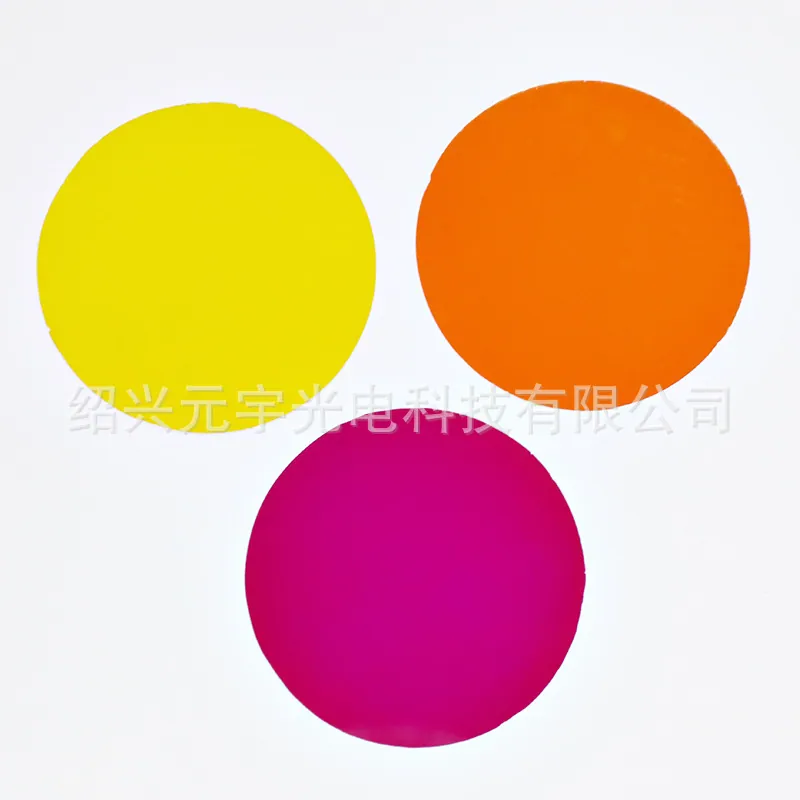
Coated Color Filters in Food and Beverage Inspection
In food and beverage inspection, that translates into a specific set of requirements rather than a general preference for quality. Sorting machines separate product from defect by comparing the light returned at a small number of bands, and each band is chosen because something in the product absorbs or reflects differently there. Chlorophyll absorbs strongly around 680 nanometres, so a band there separates leaf from stem; sugar and water absorb in the shortwave infrared near 970 nanometres, which is where internal quality is measured; and many plastics used in packaging behave differently from the food itself in the near infrared, which is how foreign material is detected. The filter decides the contrast of that comparison, and a small change in its passband translates directly into false rejects or missed defects on the line.
The tolerances that actually matter
Filter specifications for inspection are photometric and shape-driven rather than absolute. The useful numbers are the centre wavelength with its tolerance, the full width at half maximum, the peak transmission and the out-of-band blocking over the range the detector actually sees. Centring matters most where the band sits on a steep absorption edge, because a few nanometres of shift changes the contrast between two similar materials. The second cluster of numbers is mechanical and environmental: the filter has to survive the cleaning regime of the plant, which in dairy and beverage lines means caustic wash at elevated temperature and in food processing means whatever the sanitation protocol uses. A filter that meets its spectral specification and fogs or delaminates after a month of washdown is a maintenance cost rather than a measurement error, but both stop the line.
Design rules that reduce cost
Standardise the band set across the product family rather than optimising each machine. A sorter that uses four bands across three models needs four coating runs instead of twelve, and the spare parts inventory collapses accordingly. Keep the substrate thickness uniform across the range, because changing thickness changes the optical path and forces a fresh qualification on the machine. Where the band is broad, an absorbing glass filter may do the job without any coating at all, which removes a process step and a failure mode; the coating earns its place when the band is narrow, when the edge has to be steep, or when a specific blocking level is required outside the band. Finally, specify the blocking over the detector's full sensitivity range, not just around the band, because the second-order transmission of a grating and the infrared sensitivity of a silicon sensor are both routes for stray light.
Coating and deposition considerations
The coating for a washdown environment is a hard oxide stack rather than the soft fluoropolymer finish used on consumer optics, and the design has to account for the fact that both faces of the filter usually face the same environment. Where the filter is sealed into a window assembly, the coating is normally applied to the inner face and the outer surface is left uncoated or given a hard anti-reflective layer, which simplifies cleaning and reduces the risk of coating damage. Interference filters shift with angle, and a filter placed in a converging beam will show a broader, blue-shifted band compared with the same filter in collimated light, so the specification should state the incidence conditions. Where the filter is used with a high-intensity lamp or a laser line, the thermal load on the stack matters as well, and a coating designed for a camera will not survive the same flux in a focused illumination path.
How coated color filter glass works in practice
A coated color filter transmits one band of the spectrum and rejects the rest, either by absorption in the glass itself or by interference in a thin-film stack, and often by a combination of the two. Absorbing glass is simple, stable and insensitive to angle, but it is limited in how narrow a band it can produce and in how steep its edges can be. An interference stack can be designed with almost any band shape, but it shifts with angle and it depends on the deposition process for its centring, which is why the coating run number belongs in the traceability record. In an inspection machine the two are usually combined: an absorbing substrate removes the bulk of the unwanted light and a thin-film coating sharpens the edge, which gives a filter that is both stable on the line and precise enough to separate similar products.
Requirements specific to Food and Beverage Inspection
Food and beverage inspection adds constraints that a laboratory optical specification does not carry. The filter is part of a machine that is cleaned on a schedule, so chemical resistance is a functional requirement and should be written against the plant's actual sanitation protocol. Product changes with the season, which means the band set has to be re-qualified without re-designing the machine. Where the product is unpackaged, the optics sit in an environment with airborne dust and moisture, and the filter is usually sealed behind a protective window, which moves the contamination problem upstream but does not remove it. Documentation for food contact is usually handled at the assembly level rather than the filter, but the supplier should be able to state what the filter is made of.
- Centre wavelength and FWHM tied to a specific absorption feature
- Blocking specified over the detector's full sensitivity range
- Chemical resistance written against the plant sanitation protocol
- Band set standardised across the machine family to cut coating runs
Food contact requirements handled at assembly level under the applicable food contact framework, ISO 10110 drawings for the substrate, and spectral measurement on the finished part rather than on a witness coupon.
Selection data at a glance
| Parameter | Typical value | Notes |
|---|---|---|
| Band options | 400-700 nm visible, 700-1100 nm NIR | Feature specific |
| FWHM | 20-50 nm standard, 10 nm achievable | Narrower costs more |
| Centre wavelength tolerance | ± 5 nm standard, ± 2 nm on request | Edge position matters |
| Peak transmission | over 85 % in band | Absorbing glass or coating |
| Blocking | OD3 minimum over the detector range | State the range |
| Substrate | colour glass, B270 with coating, borosilicate | Combined designs common |
| Chemical resistance | caustic wash, alcohol, acidic agents | Per the plant protocol |
| Coating adhesion | tape test 4B or better after washdown | Verified on the part |
| Thickness | 1.1-3 mm typical | Uniform across the range |
Frequently asked questions
Should the filter be absorbing glass or a coated part?
Use absorbing glass where a broad band is acceptable, because it is cheaper, stable and insensitive to the angle of incidence. Move to a coated design when the band has to be narrow, when the edge has to be steep enough to separate two similar materials, or when a specific blocking level is required outside the band. Many machines use both, with an absorbing substrate doing the bulk of the work.
Why does the same filter behave differently after being fitted?
Because an interference coating shifts towards shorter wavelengths as the angle of incidence increases. A filter specified in collimated light and then installed in a converging beam will show a broader and slightly blue-shifted band. Stating the incidence conditions on the drawing prevents the mismatch.
How do I avoid false rejects when the product changes?
Standardise the band set and re-qualify the thresholds rather than redesigning the optics. If the bands are chosen around absorption features that are stable across the product range, a change of variety usually means new decision thresholds rather than new filters, which is a much faster changeover.
Need a quotation for coated color filters?
Send your drawing, target specification or coating requirement and an optical engineer will reply within 24 hours with a price and a lead time.
Request a Quote Email an engineer