A flow cytometer splits weak fluorescence emitted by labelled cells from intense excitation lasers, then routes each colour to its detector. The filters that do this must pass a narrow emission band while blocking the excitation line by several orders of magnitude. This comparison weighs absorbing coloured glass against dielectric interference filters, and sets out which tolerances actually decide sort purity.
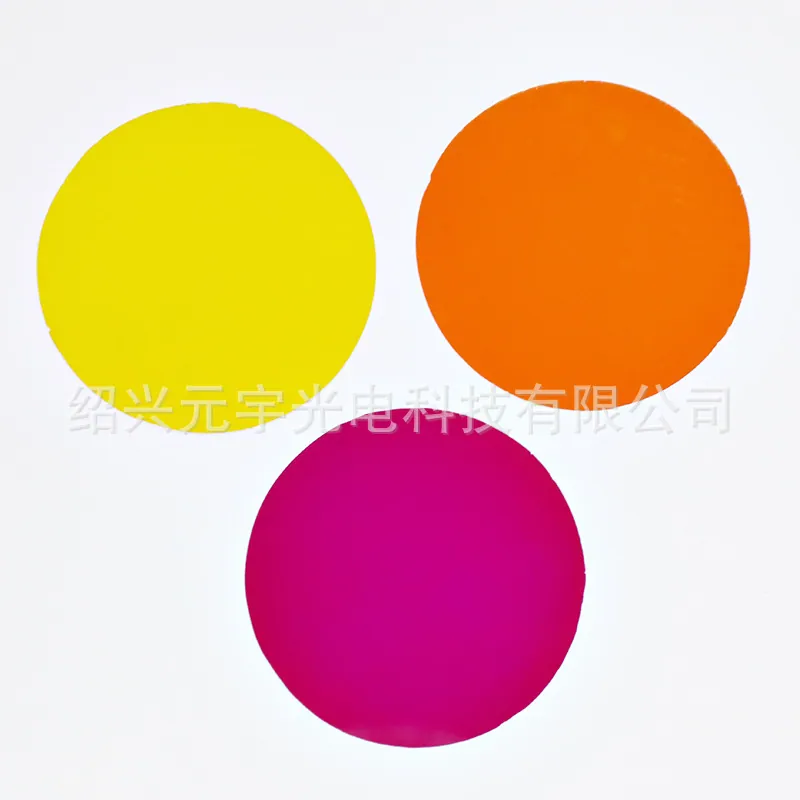
Coated Colour Filters in Cell Sorting and Flow Cytometry
In a cell sorter the sample streams past one or more lasers and the emitted fluorescence is collected through a cascade of filters: a long-pass or notch that removes the laser line, then a bandpass that selects one fluorophore's emission, then on to a photomultiplier or sCMOS detector. Every decibel of residual laser leak or out-of-band transmission shows up as background that erodes the separation between positive and negative populations. The filter is therefore specified not by its centre wavelength alone but by the combination of band position, edge steepness and blocking depth at the laser wavelengths in use.
Substrate and material selection
The choice is between absorbing coloured glass and dielectric interference coatings, and in practice most cytometer filters are dielectric on a glass or occasionally polymer substrate. Coloured glass gives very deep blocking on one side of its edge but a soft transition and a fixed edge set by the melt, so it is used where a broad long-wavelength block is needed behind a dielectric band. Dielectric stacks give the steep edges and precise centres the multi-laser environment demands. Polymer substrates are lighter and shatter-resistant for portable instruments but have weaker thermal and humidity stability than glass, which matters when the instrument sits in a warm, humid lab.
What drives cost and lead time
Band precision and blocking depth are the cost drivers. A filter that must hold its centre to a few nanometres and block the laser at optical density above six needs more layers and tighter process control than a loose bandpass. Low volumes keep prices high because each custom centre is a separate coating run. Standard catalogue centres for common laser lines ship faster and cheaper than a bespoke edge, so matching the design to an available centre is the main lever. Adding a hard, cleanable topcoat for instruments that are wiped between runs also adds a step.
The tolerances that actually matter
Centre wavelength and bandwidth decide whether the target emission is captured. Edge steepness decides how cleanly the laser line is rejected at the band edge. Optical density at the excitation wavelengths, typically required above OD 6, is the single most important number for sort purity because laser leak directly raises background. Parallelism and transmitted-wavefront error matter when the filter sits in a converging beam near the detector, since a wedge there becomes a beam shift or focus error that the alignment cannot always absorb.
How it compares with the alternatives
An absorbing coloured-glass filter is cheap and blocks deeply on its long-wavelength side but cannot give a sharp, arbitrary band, so it is a blocker, not a selector. A dielectric bandpass is the selector: precise, steep, but thinner on deep blocking unless paired with glass. A long-pass versus short-pass choice is set by whether you are collecting emission longer or shorter than the excitation. For a multi-laser sorter the practical stack is glass blocking plus dielectric bandpasses, each centred on a fluorophore and tested for laser leak rather than assumed.
Requirements specific to Cell Sorting and Flow Cytometry
A cell sorter runs multiple excitation lasers and must resolve several emission colours per cell, so the filter set is defined by the laser lines in use and the emission bands of the fluorophores. Blocking of each laser at optical density above six is the baseline for clean populations, and the filters must hold those values across the instrument's operating temperature because a warm optical bench shifts thin-film centres. Where the filter is in the emission path near a sensitive detector, low autofluorescence of the substrate and coating avoids adding background that mimics a positive event. Instruments that are cleaned between runs benefit from a hard, solvent-resistant topcoat, and any filter that contacts the sample stream must be compatible with the disinfection regime rather than merely optically correct.
- Block each excitation laser at OD above 6 to protect sort purity
- Dielectric bandpass for precise centres; glass for deep blocking
- Centre and edge steepness set capture and laser rejection
- Hold performance across the warm instrument operating range
- Low autofluorescence substrate near sensitive detectors
Framework references: optical density and band specifications are stated per laser line and emission band; substrate substance restrictions (RoHS/REACH) apply as a declaration. There is no singlecytometry filter standard, so performance is specified by the laser wavelengths and fluorophore emissions in use; confirm against the instrument manufacturer's optical layout rather than a generic value.
Selection data at a glance
| Parameter | Typical value | Notes |
|---|---|---|
| Laser blocking | OD > 6 at excitation lines | sort purity |
| Band centre | per fluorophore emission | tight tolerance |
| Edge steepness | sharp to reject laser | at band edge |
| Substrate | glass or low-auto polymer | per environment |
| Topcoat | hard, solvent resistant | cleanable instruments |
Frequently asked questions
Why is OD 6 at the laser line more important than the band centre?
Laser leak at the detector is the dominant background in a sorter. A slight centre shift loses a little signal; a few decibels of laser leak can drown the dimmest population entirely.
Can coloured glass replace the dielectric bandpass?
Only as a blocker. Its edge is soft and fixed by the melt, so it cannot give the precise, steep band a multi-laser cytometer needs. The standard design uses glass for deep blocking behind a dielectric band.
Does temperature really shift the filter?
Yes, thin-film centres move with temperature, and a cytometer bench warms in use. If the band was specified at room temperature only, the actual in-use block at the laser line can slip, so the operating range should be part of the spec.
Need a quotation for coated color filters?
Send your drawing, target specification or coating requirement and an optical engineer will reply within 24 hours with a price and a lead time.
Request a Quote Email an engineer