Reference and calibration displays use coated colour filters to fix the primaries the sensor or the eye sees, and a drift in those filters is one of the quietest ways a calibration rig loses trust. As rigs push toward tighter delta-E targets the coated filter becomes the component that has to hold its spectral shape. This troubleshooting note covers the failure modes that shift colour and the practical fixes that keep a reference stable.
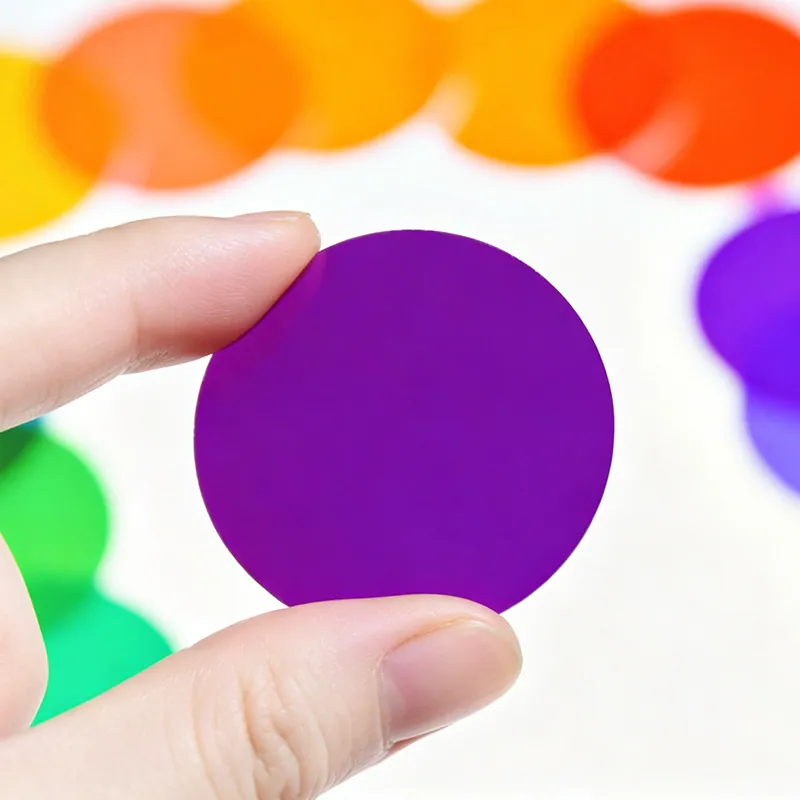
Coated Color Filters in Display Color Calibration
In a calibration rig the colour filters define the red, green and blue reference bands the instrument compares against, so their spectral edges are what the delta-E target ultimately rests on. The coating is a multi-layer stack tuned to a narrow pass band, and the substrate carries it without adding its own tint. The failure modes are mostly about that spectral shape moving over time or across the aperture rather than about the part breaking.
Design rules that reduce cost
Cost is kept down by specifying the pass band only as narrow as the delta-E target needs and by using a substrate whose own transmission is already flat across the visible, because a tinted substrate forces a more complex coating to compensate. Matching the filter set to a standard reference illuminant also avoids bespoke coating runs. The cheap filter is the one whose band was written for the calibration tolerance, not for a generic colour-glass chart.
Common failure modes and how they show up
The usual failures are coating delamination or humidity ingress that broadens or shifts the pass band, edge non-uniformity that makes the centre and corner of the aperture disagree, and a substrate tint that creeps in from a wrong grade. They show up as a drifting delta-E, a patchy colour field, or a reference that no longer matches a known source. Because the change is gradual, the first sign is often a calibration that will not converge rather than an obvious defect.
Inspection and measurement
The fix starts with a spectrophotometer sweep of the pass band at several points across the aperture, because a number on a certificate does not catch a part that has drifted since it was made. Check the band edges against the reference tolerance and map uniformity across the clear area, then compare to a known source to confirm the rig still agrees with itself. Regular re-characterisation is what turns a slow drift into a caught event instead of a silent error.
Coating and deposition considerations
The coating has to be dense and environmentally sealed, because a soft or porous stack is exactly the one that shifts with humidity and age. Stating the angle of incidence the stack was designed for matters, since a filter used off-axis moves its band. Choose a deposition process and a capping layer qualified for the rig's environment, and avoid coatings whose performance depends on a condition the rig cannot hold.
Requirements specific to Display Color Calibration
Calibration duty adds a delta-E target and a reference-traceable path to the usual optical constraints, so spectral stability and uniformity lead the specification. Choose a dense, humidity-sealed coating tuned at the rig's actual angle of incidence, use a substrate whose transmission is already flat, and re-characterise the band across the aperture on a schedule. Require a spectrophotometer sweep rather than a single certificate value, because a calibration rig has to agree with itself long after the filter left the coating chamber.
- Dense, humidity-sealed coating
- Tuned at rig angle of incidence
- Flat-substrate transmission
- Band swept across aperture
- Re-characterise on schedule
- Pass band set to delta-E need
Framework references: coating and spectral limits per ISO 10110 and the relevant colour-measurement guidance; calibration traceability follows the instrument's own documentation rules. Environmental declarations such as RoHS are the supplier's to state against the current official text.
Selection data at a glance
| Parameter | Typical value | Notes |
|---|---|---|
| Coating | Dense, sealed | Humidity |
| Substrate | Flat transmission | Visible |
| Band | Set to delta-E | Reference |
| Angle | At rig incidence | On-axis |
| Uniformity | Swept, mapped | Aperture |
| Check | Spectro sweep | Schedule |
Frequently asked questions
Why does the calibration drift if the filter looks fine?
Because the failure is a slow shift in the coating's pass band from humidity or age, not a visible defect. The first sign is usually a calibration that will not converge rather than a cracked or fogged part, which is why a spectrophotometer sweep beats a one-off certificate.
Why specify the coating angle of incidence?
Because a band-pass stack designed at normal incidence moves its band when used off-axis, and a calibration rig rarely holds the filter perfectly normal. Stating the design angle keeps the reference band where the delta-E budget assumed it would be.
What is the cheapest way to keep a stable reference?
Use a substrate whose transmission is already flat so the coating can stay simple, set the pass band only as narrow as the tolerance needs, and re-characterise on a schedule instead of assuming the filter holds its shape forever.
Need a quotation for coated color filters?
Send your drawing, target specification or coating requirement and an optical engineer will reply within 24 hours with a price and a lead time.
Request a Quote Email an engineer