Multispectral drones and ground agri-sensors read crop health by splitting reflected light into a handful of narrow bands and comparing them, and the coated colour filters that define those bands have to hold their centre wavelength and passband while riding on a vibrating airframe in dust and dew. As fleets scale, the pressure is on making those filters repeatable, repairable and traceable rather than merely colour-accurate. This note tracks the design and sourcing trends that matter for colour filters in agricultural multispectral sensing.
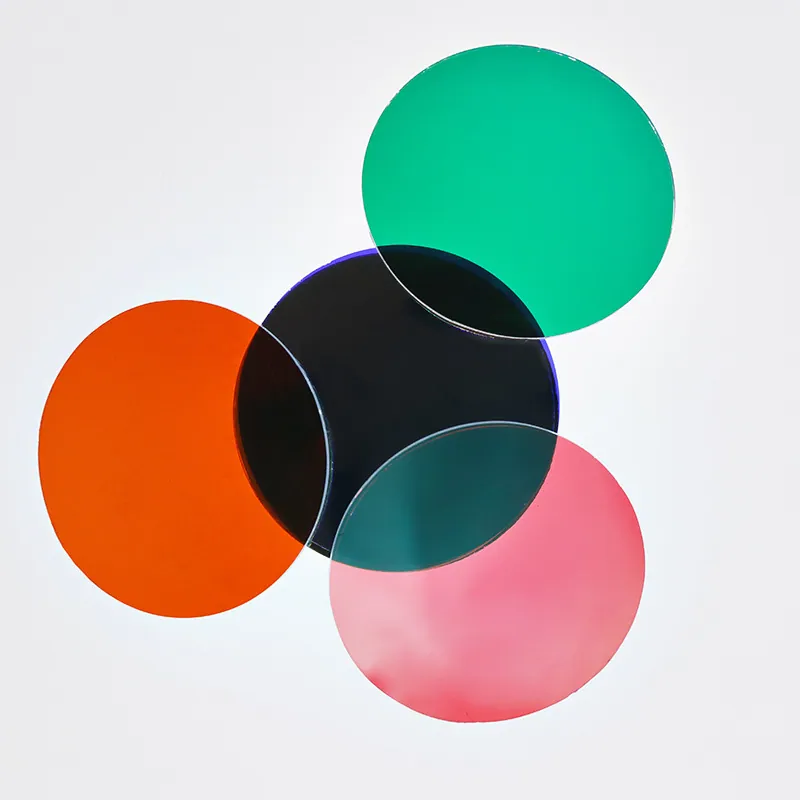
Coated Color Filters in Multispectral Drone and Agri-Sensing
Each band in a multispectral payload is set by a coated colour filter that passes one narrow window and blocks the rest, so the normalised difference between bands becomes the vegetation index the operator acts on. The filter rides on a drone that shakes, heats and gets rained on, so its centre wavelength and blocking have to stay put under that profile or the index drifts with the weather. The design trend is toward filters specified for the field, not just the bench.
How coated color filter glass works in practice
In use the filter sits over the sensor or in a filter wheel and selects the band by interference, rejecting out-of-band light so the photodiode or camera sees only the target wavelength. Drift in the centre wavelength or a softening of the blocking changes the band ratio and therefore the index, so the filter is qualified against the airframe's thermal and vibration envelope. A filter that holds its band through a flight day keeps the field data comparable field to field.
Design rules that reduce cost
Cost falls when the band set is chosen from a supplier's standard coating map rather than a one-off custom stack, and when the part count per payload is minimised by sharing a filter family across models. Specifying a forgiving substrate size and a standard coating recipe lets the part be run in a batch, and tolerating a slightly wider passband where the vegetation index allows avoids an expensive tight stack. The economical filter is the one whose band tolerance was written for the index maths, not for a perfect spectrum.
Standards, documentation and traceability
Agricultural fleets that feed agronomy decisions increasingly want each filter's centre wavelength, blocking and batch recorded so a suspect reading can be traced to a component. Documentation per ISO 10110 for the substrate and a coating data sheet stating the measured band and angle of incidence cover most procurement asks, and a lot or serial reference supports field traceability. The trend is toward filters delivered with measured band data rather than nominal values alone.
What drives cost and lead time
Lead time is driven by whether the band is a standard coating or a custom design, by the substrate size and by the measurement and documentation overhead the programme requires. Custom narrow bands and tight centre-wavelength control push the queue; standard bands with a sampled inspection ship fast. The dominant cost driver is rework from field failures, so specifying for the environment up front is cheaper than a cheap filter that drifts.
Inspection and measurement
Centre wavelength and passband are measured spectrophotometrically on samples, and the blocking is checked at the bands the index depends on, because a leak there changes the ratio. Surface quality and coating adhesion are inspected where field durability matters, and a sample from each batch is kept for traceability. The measurements that matter are the ones tied to the vegetation index, not a generic colour spec.
Requirements specific to Multispectral Drone and Agri-Sensing
Field duty makes band stability under vibration, heat and moisture the headline requirement, so specify the centre wavelength and blocking against the airframe envelope and demand measured band data per batch. Prefer standard coating maps for cost and lead time, write the passband tolerance from the index maths, and keep lot traceability so a suspect field reading can be chased to the component. A filter qualified for the flight day is cheaper than a cheap one that drifts.
- Centre wavelength stable under flight envelope
- Blocking checked at index-dependent bands
- Standard coating map preferred for cost
- Measured band data per batch
- Lot traceability for field data
- Passband tolerance from index maths
Framework references: substrate surface quality and flatness per ISO 10110, coating adhesion and band documentation per the relevant payload rule set. Environmental declarations such as RoHS are the supplier's to state against the current official text, not to be assumed for a filter component mounted on an aircraft.
Selection data at a glance
| Parameter | Typical value | Notes |
|---|---|---|
| Band | Centre + passband | Index |
| Blocking | At dependent bands | Ratio |
| Substrate | Standard size | Cost |
| Coating | Field-stable | Flight |
| Docs | Measured band data | Trace |
| Durability | Vibe, heat, dew | Field |
Frequently asked questions
Why does band stability matter more than peak transmission here?
Because the vegetation index is a ratio of bands, and a drifting centre wavelength or a leak at a blocked band changes that ratio directly, corrupting the agronomy decision. Peak transmission within a band is secondary to holding the band where the maths assumes it.
Should every filter be custom-coated?
No. Most agri payloads can be built from a supplier's standard coating map, which is faster and cheaper and still meets the index tolerance if the passband was written for the maths. Custom stacks are reserved for bands no standard recipe covers.
What documentation do fleets increasingly ask for?
Measured centre wavelength, blocking and a lot or batch reference per filter, so a questionable field reading can be traced to a component. A coating data sheet with the measured band and the design angle of incidence, plus substrate documentation per ISO 10110, covers most procurement asks.
Need a quotation for coated color filters?
Send your drawing, target specification or coating requirement and an optical engineer will reply within 24 hours with a price and a lead time.
Request a Quote Email an engineer