Tissue engineering and regenerative medicine depend on imaging to watch cells build scaffolds in real time, and that imaging leans on colour filters to separate fluorescence channels and to read structure without destructive stains. The work spans live-cell fluorescence, label-free imaging of hydrogels, and multispectral reads of engineered tissue. The design trend is away from off-the-shelf camera filters and toward filters specified per assay, with tighter band control, sterilizable housings and multispectral separation built in. This note sets out what is changing and why it matters to the optical engineer specifying the parts.
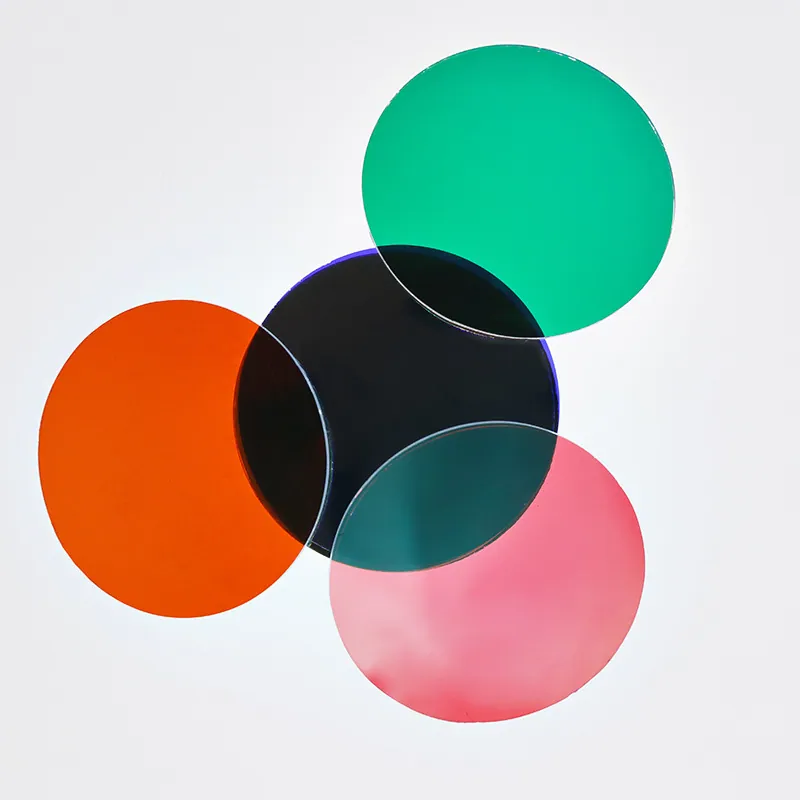
Coated Color Filters in Tissue Engineering and Regenerative-Medicine Imaging
A tissue-engineering readout is usually multispectral: a fluorescent tag on the cells, an autofluorescence band from the scaffold, and a brightfield or label-free channel for structure. Coated colour filters - dielectric bandpass and long-pass stacks on glass - sit in the emission path to separate those bands so the camera sees one channel at a time. In live-cell work the same filter set may run for days inside an incubator environment, which is what pushes the recent design changes: the filter has to hold its band while the housing is repeatedly opened, cleaned and autoclaved, and the assay has to stay quantitative as the cells grow into the scaffold.
How coated color filter glass works in practice
A coated colour filter is a thin-film stack on a glass substrate whose layer thicknesses and indices are chosen so a target band passes and everything else is reflected or absorbed. A bandpass passes a narrow window around a fluorophore's emission; a long-pass passes everything above a cut-on; a dichroic does the same at an angle inside a fluorescence cube. In tissue imaging the practical issue is spectral crosstalk: if the band edges are soft, signal from the scaffold autofluorescence leaks into the cell channel and the readout loses quantification. The coating is therefore specified by centre wavelength, bandwidth and out-of-band blocking measured against the actual fluorophores in use, not against a catalogue colour name.
Design rules that reduce cost
Match the band to the fluorophore, not to a generic green or red. A filter tuned to the real emission peak needs fewer layers than one made broadband to cover several, and it blocks crosstalk better. Keep the substrate standard optical glass unless the assay needs UV transmission or a specific thermal expansion, because exotic substrates add cost without optical gain. Where the instrument images several channels, prefer a motorised filter wheel or a dichroic set over a stack of manual filters, since that reduces the number of coated parts and the handling risk. Specify the blocking against the strongest out-of-band source - usually the excitation leak - rather than to an absolute floor that no assay requires.
Standards, documentation and traceability
Filters that enter a regulated cell-therapy or tissue-engineering workflow are documented like components: a spectral data sheet per lot, the substrate and coating identification, and a cleanliness and biocompatibility statement where the part contacts the assay environment. Drawings reference ISO 10110 for the glass element, but the controlling optical document is the filter's measured spectral curve. For work feeding a quality system, lot traceability and a statement that the coating survives the stated cleaning and sterilisation cycle matter more than a slightly tighter bandwidth. Confirm the exact sterilisation method - autoclave, vapour or UV - because not every coating survives each.
What drives cost and lead time
Cost is dominated by the number of layers and the tightness of the band. A single broadband emission filter is cheap and fast; a set of narrow, deep-blocking bandpasses for multiplexed fluorescence costs more and takes longer because each layer must be held. Lead time grows when the filter must be matched as a set across excitation and emission, or when a custom cut-on is needed for a new fluorophore. Standard catalogue bands in common sizes ship quickly; custom multispectral sets and sterilisation-qualified housings are the items that add weeks. The cheapest reliable route is to standardise on a small set of fluorophores and buy matched filter sets rather than designing each channel from scratch.
Inspection and measurement
A colour filter is accepted against its spectral curve, not against a visual colour. Inspection measures transmission across the band and blocking across the rejected regions, usually on a spectrophotometer, and the result is compared with the assay's crosstalk budget. Surface and coating defects are checked where they fall in the beam; a defect at the edge of a large filter may be irrelevant, while the same defect in a small field lens is fatal. For quantitative tissue imaging, the useful test is crosstalk between channels under the real illumination, so the measurement setup should mirror the instrument rather than a generic throughput number. Document the lot curve so later assays can be compared against the same filter history.
Requirements specific to Tissue Engineering and Regenerative-Medicine Imaging
The distinguishing need here is long, repeated runs inside a living-environment chamber, so the filter and its housing must survive cleaning and sterilisation without shifting band. The other point is quantification: as cells grow into a scaffold, autofluorescence rises, so the filter's out-of-band blocking has to hold crosstalk down across the whole experiment, not just at t-zero. Specify the sterilisation method explicitly and tie the blocking to the strongest excitation leak, because a filter that is fine for a short fixed slide may fail a multi-day tissue culture.
- Tune the band to the actual fluorophore, not a generic colour name
- Hold out-of-band blocking against excitation leak for quantitative reads
- Confirm the coating survives the stated sterilisation method
- Standardise on a small fluorophore set and buy matched filter sets
Framework references: optical element tolerances follow ISO 10110; filter acceptance is against the measured spectral curve, with sterilisation compatibility per the device's stated method. Fluorophore bands are set by the assay design; confirm against the current reagent specification rather than a catalogue colour.
Selection data at a glance
| Parameter | Typical value | Notes |
|---|---|---|
| Centre wavelength | per fluorophore emission peak | Defines the pass band |
| Bandwidth | narrow for multiplexing | Sets channel separation |
| Out-of-band blocking | deep at excitation leak | Controls crosstalk |
| Substrate | standard optical glass default | UV only if required |
| Sterilisation | autoclave / vapour / UV qualified | State method explicitly |
| Lot traceability | spectral curve per lot | For quantitative assays |
Frequently asked questions
Why not just use a standard camera colour filter?
Because tissue engineering is usually multispectral and quantitative. A generic green or red filter has soft edges and lets scaffold autofluorescence leak into the cell channel, which destroys the readout as the culture grows. The band is matched to the actual fluorophore instead.
Does the filter survive autoclaving?
Only if it was qualified for that method. Autoclave, vapour and UV sterilisation are different stresses, and not every coating survives each. State the method explicitly and confirm the housing and coating are rated for it.
How is crosstalk controlled?
By specifying out-of-band blocking against the strongest rejected source, normally the excitation leak, and by measuring the filter's spectral curve on the real instrument rather than trusting a generic throughput number.
Need a quotation for coated color filters?
Send your drawing, target specification or coating requirement and an optical engineer will reply within 24 hours with a price and a lead time.
Request a Quote Email an engineer