Hyperspectral mineral exploration reads narrow absorption features across the visible and short-wave infrared, and the optical front end has to isolate those bands at altitude and over large apertures. Coated colour filters compete here with gratings, prisms and tunable filters, and the right choice depends on how many bands you need, how much light you can spare, and how much the payload can weigh. This comparison sets out where a coated-filter front end wins and where it loses.
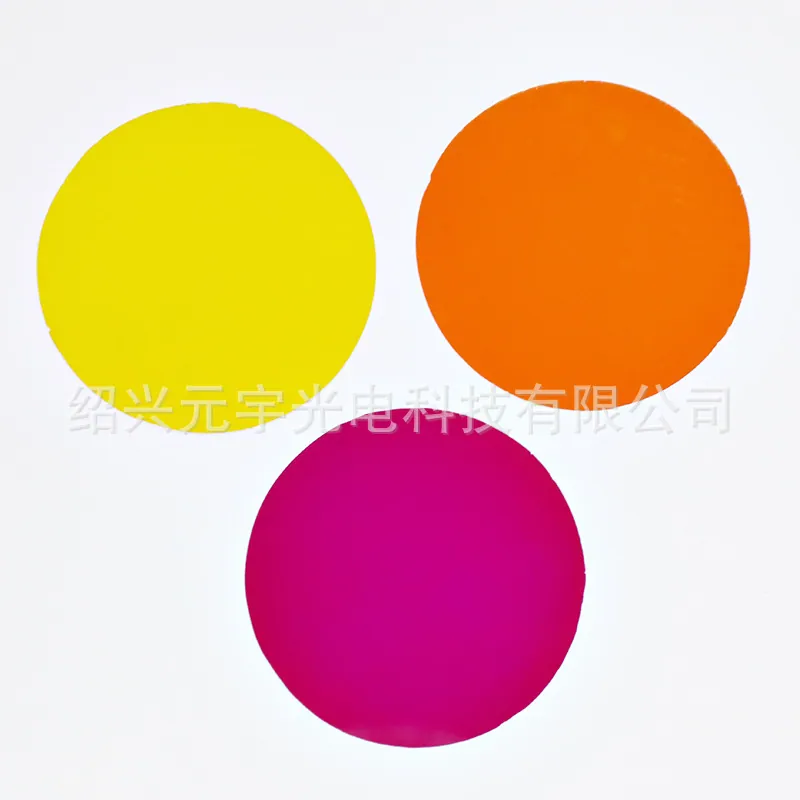
Coated Colour Filters in Hyperspectral Mineral Exploration
Airborne and satellite mineral mapping depends on narrow absorption features, especially in the short-wave infrared where clays, carbonates and hydroxyl-bearing minerals leave their signatures. The simplest front end fixes a set of spectral bands by placing coated filters in a wheel or as a mosaic over a detector, so each pixel carries a few pre-defined channels. That trades spectral flexibility for throughput and simplicity, which is often the right trade when the target minerals are known and the bands are fixed in advance.
Substrate and material selection
For mineral work the filters must hold their edge in the short-wave infrared, not only the visible, so the substrate and the coating stack are chosen for SWIR transmission and thermal stability rather than for visible appearance. A coloured-glass substrate is robust and cheap but rolls off gradually, while an interference stack gives a sharper edge and deeper blocking at the cost of angle sensitivity. For airborne use the part should also survive temperature swing and vibration without shifting its band center noticeably.
What drives cost and lead time
Cost scales with the number of bands, the steepness of the filter edge, and how large and uniform the filter must be when it covers a wide detector. A SWIR interference coating costs more than a visible one and takes longer to qualify, and a mosaic of many bands multiplies deposition and test steps. Standard detector formats and a fixed band set shorten lead time; adding a late band or tightening an edge after first article usually means rework of the whole coating lot.
The tolerances that actually matter
The numbers that move the mineral read are center wavelength, bandwidth and out-of-band blocking, because a drift in the center or a leak into an adjacent channel smears the absorption feature you are trying to detect. Angle shift matters on a wheel or a mosaic where light arrives off-normal, and surface flatness matters only where the filter sits in a converging beam. State the band center relative to the mineral feature of interest, not as an abstract tolerance, so the manufacturer tunes to what the geology needs.
How it compares with the alternatives
Against a grating spectrometer, a coated-filter front end is simpler and brighter but gives only the fixed bands you committed to, with no ability to re-point the spectrum after the flight. Against a prism it is flatter and cheaper to array but offers less dispersion. Against a tunable filter such as an acousto-optic or liquid-crystal device, the coated filter is far cheaper and more rugged but cannot scan continuously and has lower spectral resolution per band. For known-mineral surveys from a fixed payload, the coated-filter approach usually wins on cost and throughput; for reconnaissance where bands are still being chosen, a tunable or grating front end earns its price.
Requirements specific to Hyperspectral Mineral Exploration
Mineral exploration adds altitude, vibration and SWIR coverage to the usual filter constraints. Specify the band center against the specific absorption feature, hold blocking deep enough to reject adjacent channels, and qualify the filter for the airborne temperature and off-normal incidence it will see. Prefer a fixed, known band set and standard detector formats to keep the payload light and the lead time short, and keep a spectral curve per unit so flights stay comparable across a survey season.
- Band center tied to the specific mineral absorption feature
- SWIR-capable substrate and coating, not visible-only
- Deep out-of-band blocking against adjacent channels
- Angle-shift qualified for wheel or mosaic use
- Fixed known band set to keep payload light
- Spectral curve per unit for flight-to-flight comparability
Framework references: spectral quantities follow the CIE framework; where the element is a precision optic, surface quality and dimensional limits follow ISO 10110. SWIR coating and substrate choices are the supplier's to state against the current official text, and environmental declarations such as RoHS should be confirmed for field-deployed payloads.
Selection data at a glance
| Parameter | Typical value | Notes |
|---|---|---|
| Band center | Tied to mineral feature | VNIR-SWIR |
| Bandwidth | 10-30 nm typical | Edge controlled |
| Out-of-band blocking | >= OD4 typical | Adjacent channels |
| Substrate | SWIR-transmitting | Per thermal |
| Angle shift | Qualified off-normal | Wheel or mosaic |
| Documentation | Curve per unit | Traceability |
Frequently asked questions
When is a coated-filter front end better than a grating?
When the target minerals and their bands are known in advance and you want maximum light on a few fixed channels from a small, rugged payload. A grating gives you the whole spectrum to interrogate later but at lower throughput and higher cost; the coated filter gives you less flexibility and more light.
Why does the SWIR band matter for minerals?
Many alteration minerals, clays, carbonates and hydroxyl-bearing phases leave their strongest diagnostic features in the short-wave infrared, not the visible. A visible-only filter front end would miss most of what distinguishes one alteration assemblage from another.
Does a filter wheel or a mosaic suit an airborne survey?
A wheel is flexible and easier to qualify one band at a time but adds moving parts and a duty cycle. A mosaic is simpler, brighter and weighs less but fixes the bands at manufacture. For a known-mineral payload that flies repeatedly, the mosaic usually wins on reliability and throughput.
Need a quotation for coated color filters?
Send your drawing, target specification or coating requirement and an optical engineer will reply within 24 hours with a price and a lead time.
Request a Quote Email an engineer