Optical sorters on recycling and bulk-material lines separate items by hue, using a color filter in the camera path to define the pass band that tells PET from PVC or one glass colour from another. The filter is the part that decides which wavelength the sorter trusts, and when its band drifts, fades or shifts with temperature the line starts mis-sorting. This guide lists how coated color filters actually fail on a sorter and what fixes them.
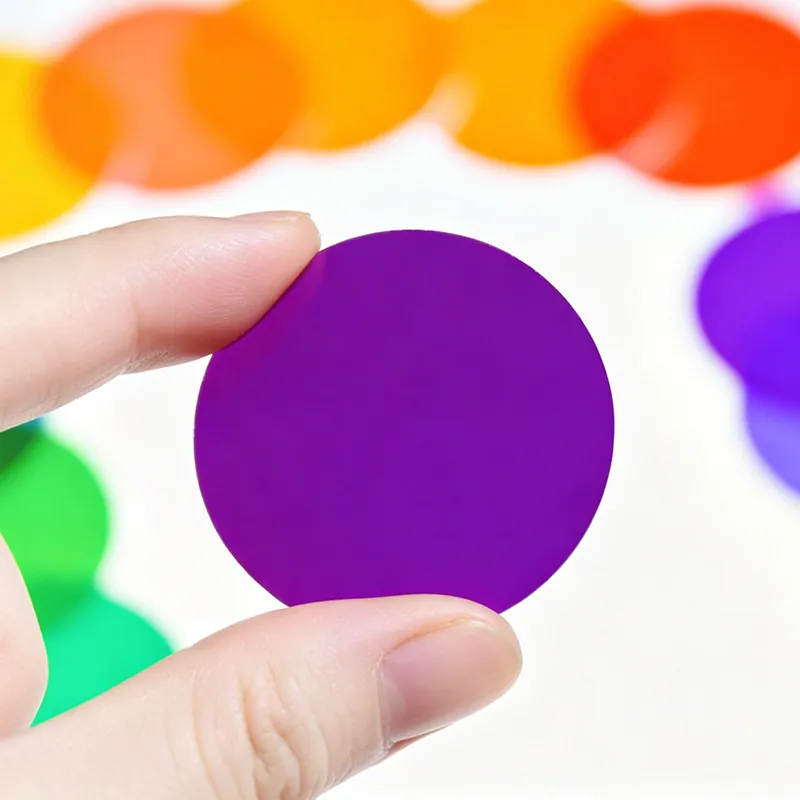
Coated Color Filters in Optical Sorting and Recycling
A free-fall or conveyor sorter flashes light at a stream of objects and reads the colour returned through a filter whose pass band is matched to the material it must catch. On a recycling line that might be separating clear from coloured PET, or pulling a specific polymer out of mixed stream. The filter is a coated dielectric stack, not a dyed sheet, because the line runs continuously and the band has to stay put. The optical problem is that the band is defined by coating thickness to nanometre precision, so anything that changes that thickness or the stack's temperature moves the cut and changes what the sorter accepts, which is why drift rather than breakage is the dominant failure.
Design rules that reduce cost
Keep the pass band standard rather than custom, because an off-the-shelf interference filter is far cheaper than a one-off centre wavelength. Use a hard-coated part and a robust mount so vibration and cleaning do not degrade it, and avoid a filter size or shape that needs special tooling. Where the line runs more than one material, prefer a filter set that shares a substrate family so spares and calibration stay simple. The saving is in standardisation and in a coating hard enough to skip frequent replacement, not in shaving the substrate to the minimum.
Common failure modes and how they show up
Band fade from UV and heat shows as a centre-wavelength shift and a rise in mis-sorts that worsens over a shift. Surface abrasion from dust adds haze that lowers contrast at the cut. Temperature drift moves the centre wavelength enough to change which material passes, most visible on a line that runs warm in summer. Delamination shows as patchy transmission, and contamination from oil or dust on the surface changes the effective band. None of these breaks the glass; they change the number the sorter reports, so the first sign is usually a quality log, not a visible fault.
Inspection and measurement
Check the band with a spectrophotometer per lot, not just at incoming, and include a centre-wavelength measurement across the operating temperature because the drift is the thing that bites. Adhesion is tested by a tape or equivalent framework pull, and environmental aging by a humidity-and-heat soak that mimics the line. A reference sample is kept aside and the sorter is recalibrated against it on a schedule, so a slow band shift is caught before it reaches the product. The lot certificate records the as-measured band and its temperature coefficient, which the calibration step then uses.
Coating and deposition considerations
Specify a hard dielectric interference filter rather than a dyed gelatin, because the dyed part fades under UV and heat and drifts in band, while the coated stack holds its cut far longer. Where lines run under daylight or near a UV source, the coating must be stable to that exposure, and the operating temperature range has to be stated on the order so the centre-wavelength shift is designed in, not discovered later. The substrate is chosen for thermal stability so the band does not move with the housing, and the coating is qualified for the cleaning agents the line uses.
Requirements specific to Optical Sorting and Recycling
A sorter runs at high throughput, around the clock, in a dirty and vibrating environment whose temperature varies through the day and the season. The filter is field-replaceable and calibrated against known reference samples, because a mis-sort is a cost per tonne, not a cosmetic flaw. The band must be stable across the real operating temperature, and the part must resist dust abrasion and the line's cleaning agents. The specification is written around recalibration and a lot spectral check, so a failing filter is caught by procedure before it reaches the product rather than by a surprise in the yield.
- Stable dielectric interference filter, not dye
- Lot spectral check including centre-wavelength vs temperature
- Hard coating resisting dust abrasion
- Defined recalibration against reference samples
Framework references: interference-filter centre-wavelength and temperature-coefficient behaviour, adhesion and environmental-aging tests against an equivalent framework (e.g. MIL-class), and a lot spectral certificate. Confirm against the component maker's current datasheet and the line's own calibration procedure rather than a single value.
Selection data at a glance
| Parameter | Typical value | Notes |
|---|---|---|
| Pass band | per sort spec, 20-50 nm | Material dependent |
| Centre drift | documented over operating temp | Calibrated |
| Transmission | per band | Hard coated |
| Substrate | borosilicate, temp-stable | Per line |
| Hardness | hard oxide, abrasion-resistant | Field grade |
| Inspection | spectro per lot plus temp test | Reference sample |
| Mount | vibration-isolated, replaceable | Field service |
Frequently asked questions
Why does an interference filter mis-sort as it heats up?
The centre wavelength of a dielectric stack shifts with temperature, so on a line that runs warm the pass band moves enough to change which material passes. The filter must be specified and calibrated over its real operating temperature, with the shift taken from the lot certificate rather than ignored.
Dyed or coated filter for a sorter?
Dyed filters fade under UV and heat and drift in band; a hard dielectric interference filter holds its band far longer. Sorters that run continuously favour the coated part despite the higher first cost, because the alternative is recalibrating against drift every few weeks.
How do I catch a failing filter before it mis-sorts?
Keep a reference sample and recalibrate the sorter against it on a schedule. A spectrophotometer band check per lot plus a temperature-dependent centre-wavelength test catches most drift before it reaches the line, and the lot certificate records the numbers the calibration step uses.
Need a quotation for coated color filters?
Send your drawing, target specification or coating requirement and an optical engineer will reply within 24 hours with a price and a lead time.
Request a Quote Email an engineer